Most roofing marketing advice is written by people who have never counted a roofing ad. So we counted them. Across 17 metros, we checked 834 roofing companies and confirmed 447 of them, 54%, are running paid ads right now. Then we read 2,484 of their creatives one by one: the headline, the offer, the photo, the phone number.
This article is what that data says. Not what roofers should theoretically do. What the ones spending real money actually run.
How many roofers are actually advertising?
Just over half. 447 of the 834 companies we checked have at least one live ad. That number moves a lot by market. In Houston, 35 of the 50 companies we checked are advertising, a 70% rate. In Tampa it is 66%. In Atlanta it is 30%, and in Minneapolis 36%.
Read that both ways. In a Houston or a Tampa, sitting out of paid means the majority of your competitors are visible where you are not. In an Atlanta or a Minneapolis, the field is mostly dark, and a modest budget buys a lot of presence.
Where does the money go?
Google, almost entirely. The 447 advertisers run 4,572 live Google ads against 141 live Meta ads. That is a 32 to 1 ratio. 409 companies advertise on Google, 75 on Meta, and only 37 run both platforms at once.
The reason is intent. Nobody scrolls their way into a roof replacement. A roof gets bought when it leaks, when hail hits, or when an inspector flags it, and at that moment the homeowner searches. Google captures the search. We break down the platform gap in detail in Facebook ads for roofers, and the Google side in what 4,572 live ads reveal.
What does the typical advertiser look like?
Smaller than you would guess. The median Google advertiser in our data runs 3 live ads. 263 of the 409, about 64%, run 5 or fewer. This is the long tail: one campaign, a handful of ads, left to run.
Then there is the top of the market. 60 advertisers run 20 or more live ads, 20 run 50 or more, and 47 were still going when our per-advertiser count stopped at 200. Companies like Parker Brothers Roofing in Oklahoma City and Best Choice Roofing in Nashville each show 200+ live ads. The gap between the median roofer and the biggest advertiser in the same city is not 2x. It is closer to 70x.
What do the ads actually say?
We read 2,484 creatives and tagged the main angle of each. Quality and craftsmanship leads at 32%. Trust, local, and family framing takes 21%. Price and affordability is only 8%, storm and hail damage 8%, and speed or urgency 6%.
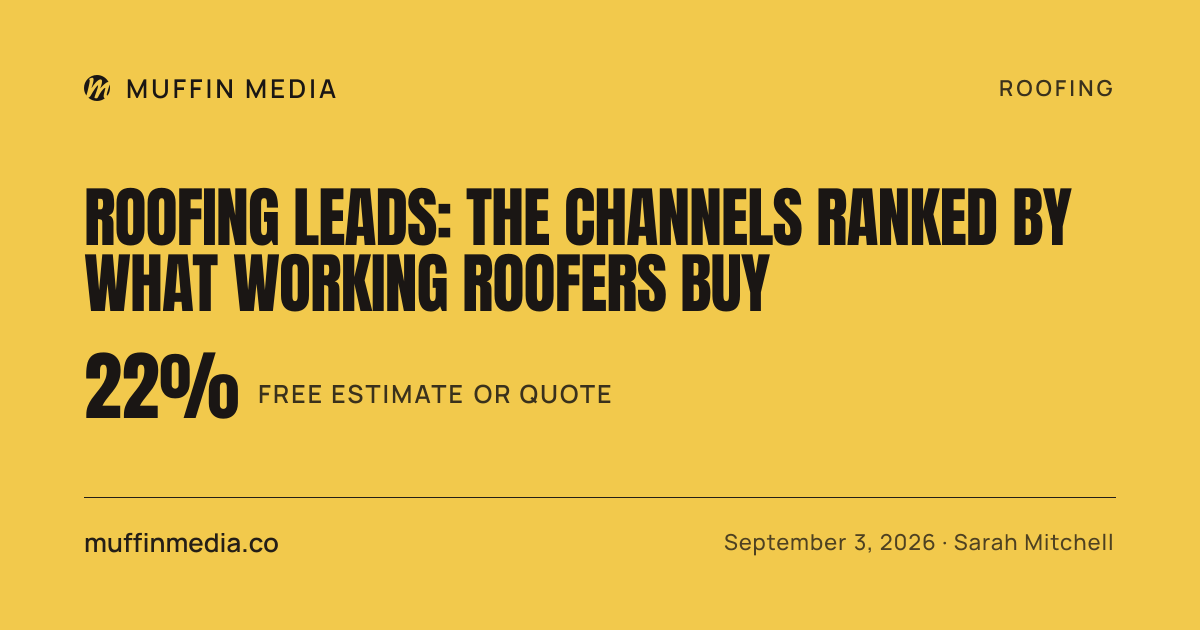
The offer data is the surprising part. 53% of ads carry no offer at all. A free estimate or quote appears in 22%, a free inspection in 12%, financing in 3%. Roofers are paying for clicks and then asking the homeowner to figure out the next step on their own.
53% of roofing ads carry no offer at all. Half the market is paying for attention and then wasting it.
What almost nobody runs
Some absences in 2,484 creatives are worth naming. Before and after photos appear in 0.2% of ads. An owner's face shows up in under 2%. A customer or family in under 1%. 83% of ads show no person at all. A phone number appears in 25%, trust badges in 28%.
Every one of those gaps is an opening. A roofing ad with a real crew photo, a named owner, and a specific offer is competing against ads that have none of the three.
The part most roofers get wrong: stopping
For each advertiser we tracked the longest-running live ad. The median is 420 days. 230 of the 409 Google advertisers, 56%, have an ad that has run for over a year. 107 have one past two years. The longest we found, from Murphy & Sons Roofing in Kansas City, has been live for 1,739 days.
The companies buying roofing work from ads are not sprinting between storms. They keep campaigns live for years, which means the algorithm has years of conversion data and the brand has years of repetition. If your plan is to advertise for six weeks after the next hailstorm, you are competing against someone on day 1,200.
What to do with this
The data suggests a plain sequence. Start on Google search, because that is where 409 of your 447 advertising competitors already confirm the demand is. Put a specific offer in every ad, because half the market runs none. Use real job photos and real people, because almost nobody does. Then leave it running.
If you want to know exactly who is advertising in your metro before you spend, that is what we built the benchmark for. Muffin Intel tracks the ads, we read them, the written benchmark lands inside one business day.
Frequently asked questions
How much of the roofing market is advertising?
In our 17-metro pull, 447 of 834 roofing companies, 54%, have at least one live ad. The rate ranges from 30% in Atlanta to 70% in Houston. Storm-heavy metros generally sit above the average and low-storm metros below it, so check your own market before assuming it is crowded or empty.
Should a roofer advertise on Google or Facebook first?
Google first, by the revealed preference of the market. Working roofers run 4,572 live Google ads against 141 on Meta, and 409 of the 447 advertisers are on Google. Roof demand is triggered by events and captured by search. Meta has real uses, mostly for planned purchases like metal roofing and for retargeting, but it is the second channel, not the first.
What should a roofing ad actually include?
The elements most of the market skips: a specific offer, a real photo, and a person. 53% of the 2,484 ads we read carry no offer, 83% show no human, and 0.2% use a before and after. A free inspection or free estimate offer, a crew or owner photo, and a visible phone number put you ahead of the majority of live ads in your city.
Free
See what your market is advertising
Written by Sarah Mitchell, Muffin Media

Want this run on your brief?