Muffin Media pulled live ad data from the 50 most-reviewed med spas in each of 10 cities, 500 spas total. The finding that stands out most isn't who's advertising. It's who isn't. Across markets ranging from Buckhead to Stamford, the majority of med spas are sitting out the paid channel entirely, ceding high-intent traffic to a small group of operators who figured out the math. Only 206 of the 500 spas (41%) were running live ads on Google or Meta at the time of our pull. That number drops below a third in some cities.
This is a flagship data report built on our national dataset of 1,995 spas. The city-level data below is drawn from the most competitive zip codes in each market.
Which cities have the most med spa advertising activity?
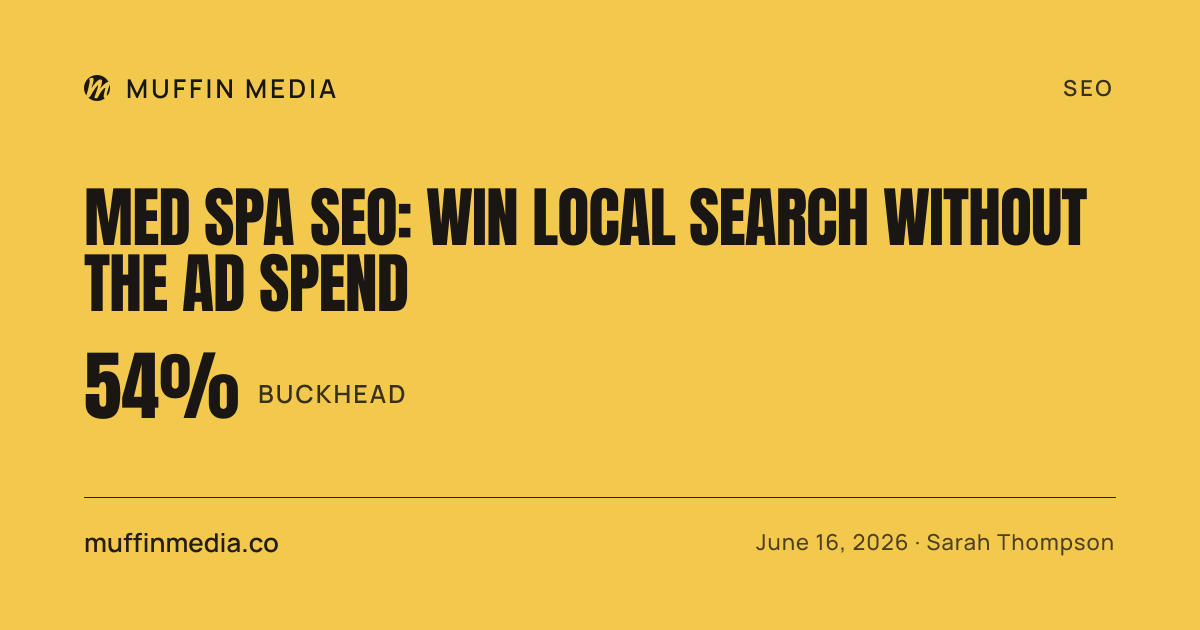
Buckhead leads the ten markets at 54%, meaning more than half the top-reviewed spas in that Atlanta neighborhood are running paid ads. Alpharetta follows at 52%. Greenwich sits at 48%. Those three markets stand apart from the rest. Drop below them and the numbers tell a quieter story: Boca Raton and Plano both clock in at 42%, Scottsdale at 38%, Frisco at 36%.
Newport Beach and Coral Gables both sit at 34%, and Stamford brings up the rear at 32%. That means in the least active market in this dataset, roughly two out of three top-reviewed spas are running zero paid ads against competitors who are. The floor of this dataset is already the top tier of US markets by volume and review count. In smaller or less affluent cities, the advertising gap is likely wider.
The takeaway for operators is direct: even in Buckhead, the most active market we measured, nearly half the competition has no paid presence. The paid auction in most of these cities is being contested by a minority.
Does Google or Meta win the med spa advertising battle?
Google wins, and it isn't particularly close. Across the full 500-spa dataset, 167 spas were running Google ads versus 66 on Meta. On a raw creative count, Google had 656 live ads against 133 on Meta, a 4.9x difference. For a fuller comparison of both platforms, the channel dynamics differ by intent, but the aggregate spend signal is clear: med spa owners are betting on search.
The reasoning holds up operationally. Someone searching "botox near me" has already decided they want the treatment. Meta catches people who haven't made that call yet. Both have a role, but the majority of advertising spas are prioritizing the high-intent query over the awareness play. Google's dominance in this data almost certainly reflects that conversion economics are easier to close on search.
Across 500 med spas in 10 cities, Google ran 4.9 times as many live ads as Meta. One market flipped that ratio entirely.
Where does Meta actually beat Google?
Newport Beach is the only market in this dataset where Meta outperforms Google. The numbers: 36 live Meta ads versus 27 live Google ads. Every other city in the set runs the opposite ratio. That inversion is worth examining.
Newport Beach is a high-income coastal market where the client profile skews toward brand affinity over urgent need. The clientele browsing balayage and preventative injectables may be more reachable on Instagram than on the search bar. The operators running Meta-heavy campaigns there may have figured out their customer's actual discovery behavior, which in that zip code appears to be visual and social rather than transactional. It's one market, not a universal signal. But if you're running a luxury-positioned spa in a coastal affluent city and your current mix ignores Meta, Newport Beach is worth a look.
Is any market completely lopsided on one platform?
Coral Gables presents the most extreme case in the dataset. Every advertising spa in that market runs on Google. The Meta number is zero. That's not a slight preference for search, that's total platform concentration. Whether that reflects a market that hasn't discovered Meta's local targeting capabilities or an environment where search intent is so dominant that Meta hasn't earned a test budget, the outcome is the same: if you want to reach Coral Gables spa clients via paid advertising, Google is the only game in town among current competitors.
This also means Meta is a wide-open channel in Coral Gables for any operator willing to run the experiment. Zero existing competition in the ad auction on a platform reaching the same local affluent audience is a gap worth considering.
Who are the most aggressive individual advertisers in these markets?
Two operators stand out by a significant margin. NicholsMD of Greenwich is the most strategically aggressive advertiser in the dataset, not because of creative volume alone, but because of geography. NicholsMD holds the top advertiser position in Greenwich with 20 live ads and simultaneously runs 21 live ads in neighboring Stamford, making it the number-one advertiser in both cities at once. A Greenwich-based spa is cross-market targeting, pulling Stamford clients with paid search while dominating its home market. That's a specific and deliberate strategy, not accidental spend.
The single highest creative volume for any individual spa belongs to Zubowicz Aesthetics in Alpharetta, which runs 26 live Google ads. To contextualize that number: the median advertising spa in our dataset runs far fewer active creatives. Running 26 simultaneous Google ads signals active testing across multiple services, audiences, or offer angles. Alpharetta's 52% advertising rate combined with that kind of concentrated spend at the top of the market means Zubowicz has likely locked in a significant share of high-intent local search traffic.
Both operators illustrate the same principle. The market leaders in these cities aren't running one or two ads and hoping. They're running campaigns with enough creative depth to dominate multiple searches.
How does this compare to the national picture?
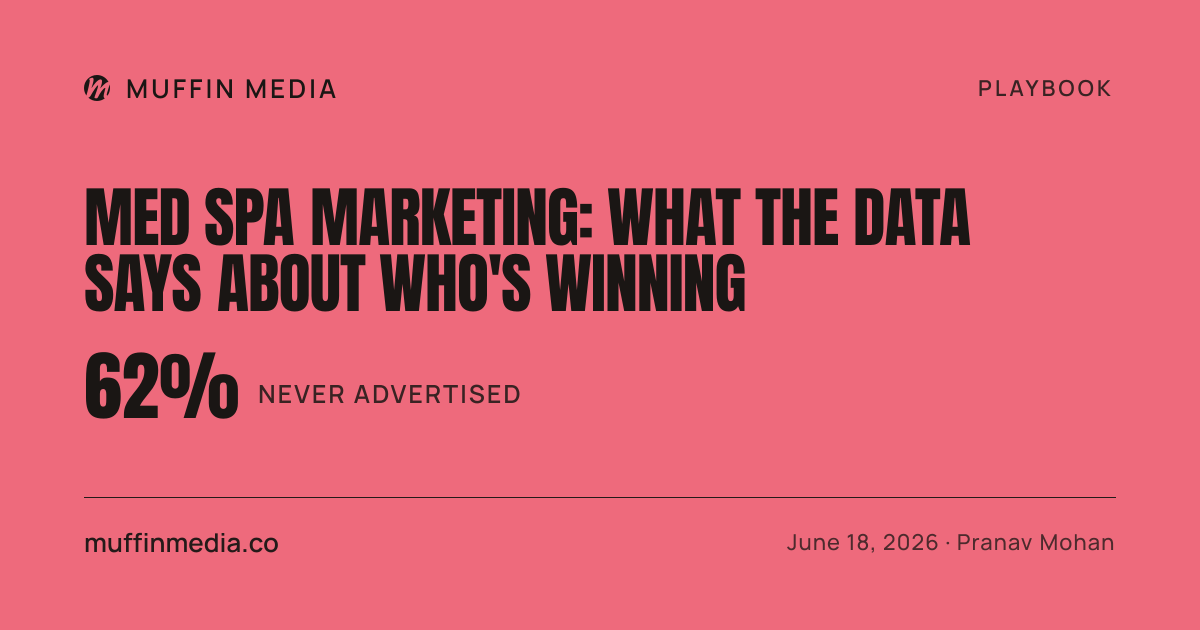
Our national advertising statistics dataset covers 1,995 med spas and shows a picture more extreme than any individual city in this report. Nationally, 62% of med spas have never advertised on Google or Meta. Not "aren't advertising right now." Never. The 10 cities in this report are among the more active markets in the country, which is why we selected them. Even so, they reflect the same underlying dynamic: most of the market is not in the paid auction.
Among the spas that do advertise nationally, 87% fall into what we classify as beginner maturity. A spa at beginner maturity is running ads but hasn't built the creative depth, campaign structure, or audience testing to compete seriously with operators who have. The average longest-running ad in the national dataset has been live for 478 days. That's not a carefully maintained campaign. That's an ad someone turned on and forgot. The gap between the few sophisticated advertisers and the majority of the market is wide, and it shows up in the city data above in the form of a handful of operators running dozens of creatives while competitors run none.
What does this mean if you're running a med spa?
The data points in one direction. In most of these markets, building a competent Google Ads presence would immediately place your spa among a minority of competitors. In markets like Coral Gables or Stamford, even a modest Meta budget would face no paid competition at all from existing advertisers. The absence of competitors from the paid channel isn't a sign that advertising doesn't work. The NicholsMD and Zubowicz examples are direct evidence of what aggressive advertisers are doing with the space everyone else has left open.
The 478-day average ad lifespan nationally tells a different kind of story. Many of the spas counted as "advertising" in our data are technically active but functionally inactive, running stale creatives against audiences they haven't revisited in over a year. The real competitive gap isn't just between advertisers and non-advertisers. It's between operators who are actively managing campaigns and everyone else. In most of the markets in this report, that second group is small enough to count.
Frequently asked questions
What percentage of med spas advertise on Google or Meta?
In our 10-city dataset of 500 top-reviewed med spas, 41% were running live paid ads at the time of our pull. That figure drops as low as 32% in Stamford and peaks at 54% in Buckhead. The national picture is more stark: across a broader 1,995-spa dataset, 62% of med spas have never run a paid ad on either platform. The implication for individual operators is that entering the paid channel, even at a basic level, places them ahead of most local competitors by default.
Why does Google dominate med spa advertising over Meta?
The platform-level split in our data shows 167 Google advertisers versus 66 Meta advertisers, with Google producing 656 live ads against Meta's 133. The likely explanation is intent: someone searching for a specific treatment on Google has already decided they want it, which makes the conversion path shorter and the return on spend easier to calculate. Meta's strength is in visual discovery and audience targeting, which suits brand-building and reaching clients before they're actively searching. Most med spa owners who have experimented with both tend to see more direct, measurable return from Google first, which is what the aggregate spend signal reflects.
Is there a market where advertising competition is especially thin?
Stamford stands out at 32%, meaning roughly two in three top-reviewed spas in that city are running no paid ads. Coral Gables at 34% has zero Meta advertisers among the spas that do advertise, leaving that platform entirely open. Even the most competitive market in our dataset, Buckhead at 54%, leaves nearly half the top spas outside the paid auction. Across all 10 cities, the consistent finding is that paid advertising in med spa is concentrated among a small minority of operators, and the most aggressive of those, like NicholsMD running 20 to 21 ads simultaneously across two cities, are compounding that advantage every month the majority stays out.
Free tool
See the live ad benchmark for your city
Written by Pranav Mohan, Muffin Media

Want this run on your brief?