We pulled live ads from 500 med spas across 10 cities and analyzed 1,995 nationally. Here is what the data shows.
Most med spas are not advertising. The ones that are tend to stick with Google, run the same creative for well over a year, and ignore Meta entirely. The numbers are specific enough to be useful, and that is the point: the aesthetics SERP is full of recycled, unsourced stat lists. This article cites primary data from Muffin's proprietary pull, updated for 2026. Bookmark it, share it, or use it to benchmark your own clinic.
How many med spas actually advertise right now?
Only 16.5% of med spas are running digital ads at this moment. That is the live advertising rate across our 500-clinic, 10-city pull.
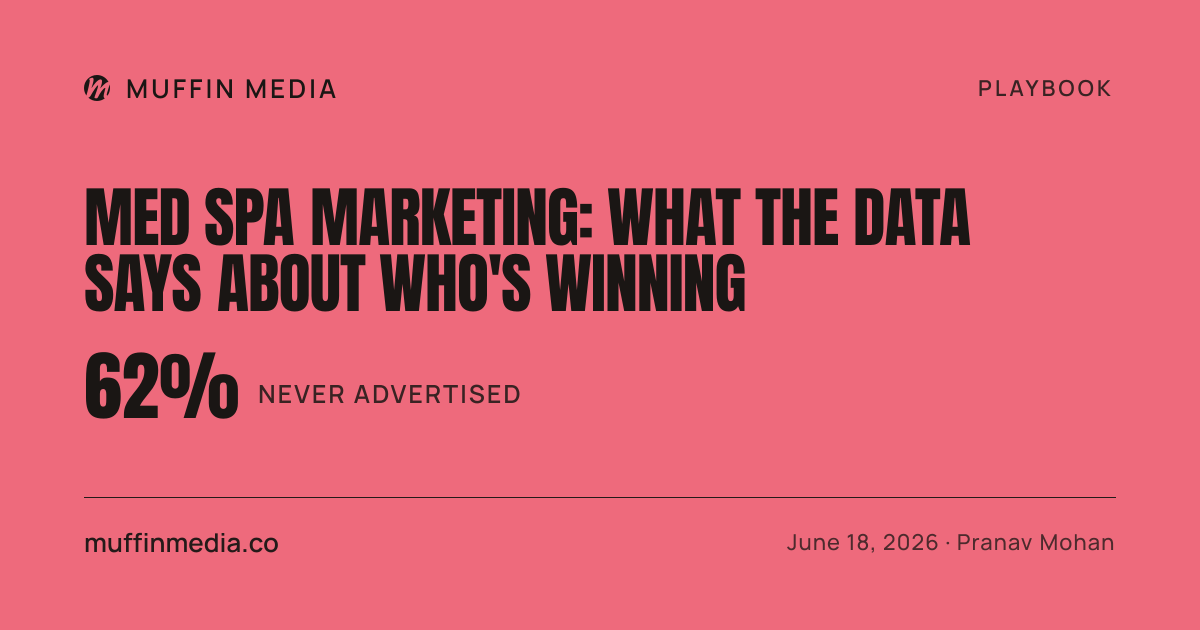
The fuller picture: 38% of med spas have tried digital advertising at some point, but only 16.5% have something running today. That means roughly 21.5% tried it, stopped, and moved on. The majority, 62%, have never run a single digital ad.
For any clinic that has been advertising consistently, the practical implication is clear: the competitive window is wide open. In most markets, you are not fighting 80% of your local competition for ad real estate. You are fighting fewer than one in five.
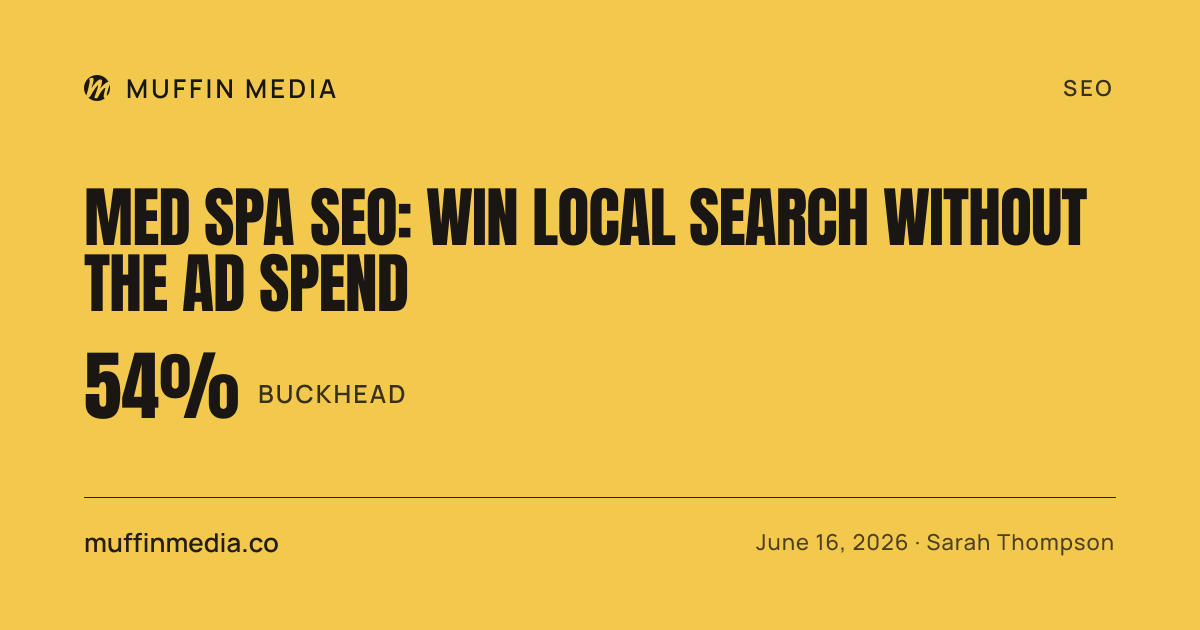
City-level data shows this gap is real but uneven. Buckhead, GA sits at a 54% advertising rate, the highest in our sample. Buckhead med spa marketing is a genuinely contested market. Stamford, CT sits at 32%, the lowest. If you operate in a low-adoption city, the first mover advantage is still available.
Is Google Ads or Meta the dominant channel for med spas?
Google. By a wide margin.
Across our 500-clinic pull, we found 167 active Google advertisers versus 66 on Meta. That is a 2.5:1 ratio in raw advertiser count. When we look at total ad volume nationally across the 1,995-spa dataset, med spas run 4.8x more ads on Google than on Meta. The 10-city pull puts the ratio at 4.9x.
One market, Coral Gables, FL, had zero med spas advertising on Meta. Every single advertising clinic in that city was running Google Ads only.
This is not surprising if you think about how patients search for aesthetic treatments. Someone ready to book a HydraFacial or a Botox appointment types "med spa near me" into Google. They are not browsing Instagram waiting to be interrupted. Google captures intent; Meta captures attention. Intent converts faster, and the data reflects it.
That said, Meta is not irrelevant. Instagram for med spas works for brand awareness, retargeting, and building the kind of visual credibility that aesthetic clinics need. The 66 Meta advertisers in our pull are not making a mistake. They are just a smaller group.
For a deeper breakdown of how to structure a Google campaign specifically, see med spa Google ads that work.
What ad formats do med spas use on Meta?
Video leads at 41%, followed by carousel at 30%, and static image at 29%.
The split is close enough that no single format dominates. Video edges ahead, which tracks with organic social behavior: short-form video performs well on Instagram and Facebook, and advertisers have followed. Carousel is useful for showing multiple treatments or before/after sequences in a single ad unit. Static image is the fastest to produce and still accounts for nearly a third of spend.
For clinics starting out on Meta, carousel tends to be underused relative to its performance. It is worth testing before defaulting to video, especially if production resources are limited.
Med spas run 4.8x more ads on Google than Meta nationally. In Coral Gables, 100% of advertising clinics are on Google and zero are on Meta.
How long do med spa ads typically run?
The average longest-running ad per clinic is 478 days. The single longest ad in our dataset has been running for 2,886 days.
That number surprises most people. Nearly eight years on a single creative. Even setting aside the extreme outlier, 478 days as an average means med spa advertisers are not refreshing their creative on any meaningful schedule.
42% of med spas that have ever advertised are keeping a campaign running for 180 days or more. That is not a testing phase. That is a sustained, ongoing commitment to a channel.
The durability of these campaigns has two interpretations. One: med spas find a formula that works and they leave it alone, which is reasonable media behavior. Two: many are running stale creative without monitoring performance, which is a waste. Without conversion data you cannot tell which camp a clinic is in from the outside, but the sheer length of these runs suggests the second scenario is common.
From a competitive standpoint, if you are entering a market where the incumbents have been running the same ad for 400 days, there is a good chance the creative is tired and you can out-compete on freshness alone.
How sophisticated are med spa advertisers?
Not very. 87% of med spas with active ad accounts are rated at beginner maturity. Zero percent are rated advanced.
The maturity rating here comes from platform signals: account structure, campaign types used, bidding strategies, and ad variety. A beginner account typically has one or two campaigns, limited ad group segmentation, and no conversion tracking set up correctly. An advanced account has full-funnel structure, audience layering, and performance data driving bid decisions.
The 0% advanced finding is the most striking. In a 500-clinic sample across 10 major markets, not one med spa is running what would be considered a sophisticated ad operation.
This has a direct implication for any clinic willing to invest in proper setup. You are not competing against well-resourced, optimized accounts. You are competing against beginner campaigns with stale creative. The bar is genuinely low.
For a full breakdown of what a correctly structured med spa campaign looks like, the med spa marketing guide 2026 covers channel strategy from the ground up.
What do med spas spend on digital advertising?
Our dataset tracks ad existence, volume, format, and longevity. It does not capture spend directly. For budget ranges and cost benchmarks, the following are industry-standard figures, not Muffin proprietary data.
Industry benchmarks put Google Ads cost-per-click for aesthetic treatments between $4 and $15, depending on the market and keyword competitiveness. High-intent terms like "Botox near me" in major metros can run toward the top of that range. Cost-per-lead benchmarks typically sit between $30 and $90 for med spas, though heavily contested markets push higher.
Monthly ad budgets for clinics seeing meaningful volume generally start around $1,500 to $2,000 for Google Ads and scale from there based on market size. These are starting points, not guarantees.
For anything compliance-related, including what you can and cannot claim in aesthetic advertising, see med spa advertising compliance. Platform policies on before/after imagery, medical claims, and targeting restrictions are worth understanding before you build out a campaign.
Does advertising actually vary by city?
Yes, significantly.
Across our 10-city pull, the advertising rate ranges from 32% in Stamford to 54% in Buckhead. That 22-percentage-point spread means the local competitive environment matters as much as the national averages.
Scottsdale med spa marketing sits in a different position than a mid-market like Stamford. High-income, high-density markets with strong aesthetic culture tend to have more advertisers. But even in those markets, the majority of clinics are not running ads.
If you are trying to decide whether to advertise in your city, the relevant question is not "how many spas are there" but "how many are actually advertising." Our per-city data in the med spa advertising research report 2026 breaks this out in full.
For clinics thinking about lead generation more broadly, paid search is one channel. Local SEO, referral programs, and membership structures all work alongside it. See med spa memberships and retention and local SEO for med spas for the non-paid side of the equation.
Frequently asked questions
What percentage of med spas advertise digitally?
Only 16.5% of med spas are running active digital ads at any given time, based on Muffin's live pull of 500 clinics across 10 cities. A further 21.5% have tried advertising in the past but are not currently running anything. That puts 62% of the industry with no digital ad presence at all, a figure that holds across the broader 1,995-spa national dataset as well.
Do med spas advertise more on Google or Meta?
Google by a wide margin. Across the 500-clinic pull, there are 167 active Google advertisers versus 66 on Meta, a ratio of roughly 2.5:1 in advertiser count. At the ad volume level nationally, med spas run 4.8x more ads on Google than Meta. One market, Coral Gables, had zero Meta advertisers among its advertising clinics.
How long do med spa ad campaigns typically run?
The average longest-running ad per clinic in our dataset is 478 days. The single longest is 2,886 days. 42% of med spas that have advertised at any point are keeping campaigns live for 180 days or more. This suggests most clinics are not running short-term tests. They find something that works and leave it running, sometimes long past the point where the creative is still performing well.
Free tool
See the live ad benchmark for your city
Written by Sarah Thompson, Muffin Media

Want this run on your brief?