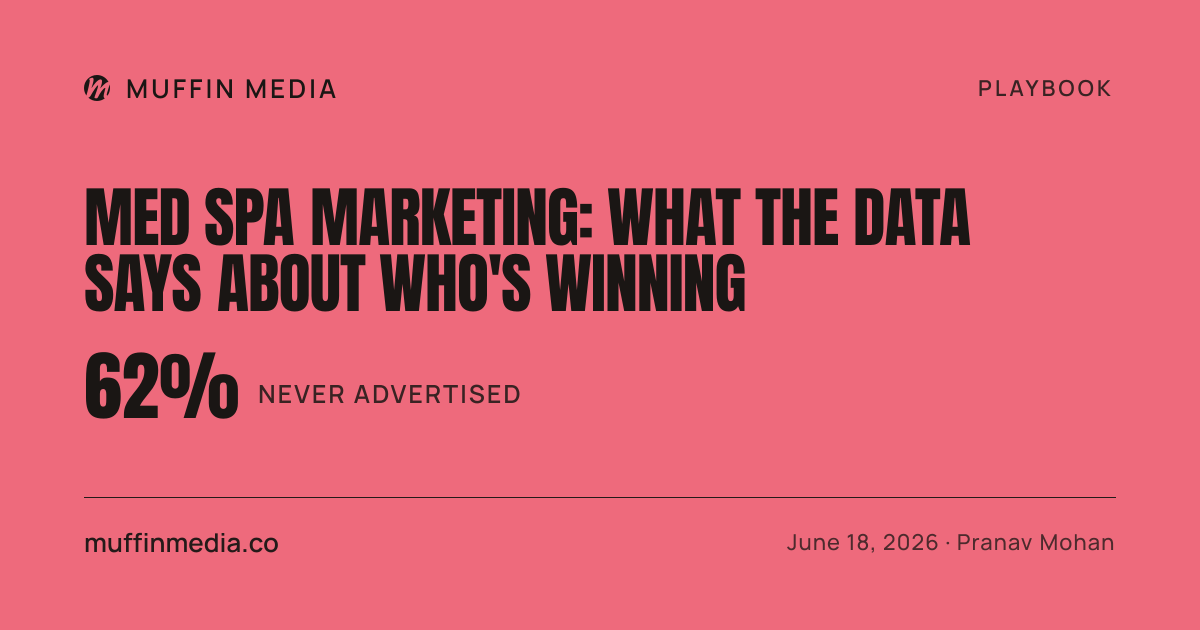
With 41% of competitors advertising in top markets, content is how you build an asset instead of renting clicks. Our pull of 500 med spas across 10 cities found that 62% of spas nationwide have never run a single digital ad. That means most of the industry is invisible online, and the ones who are visible are mostly paying to be seen, one campaign at a time. Content changes that math.
This article walks through what our proprietary data shows about where attention is being bought, where it is being built, and why the education gap across every city we measured is the open lane for any med spa willing to write it down.
Why does content marketing matter more than ads for a med spa?
Content compounds. A paid ad stops delivering the moment your budget hits zero. A well-optimized article about "what is RF microneedling" keeps pulling in organic traffic for months or years after you publish it.
Our data confirms this dynamic at the market level. The average longest-running med spa ad runs 478 days. The maximum we recorded was 2,886 days, which is nearly eight years. That is exceptional. The reality for most spas is choppier: only 42% of med spas that have ever advertised keep a campaign active for 180 days or longer. The majority cycle on and off, which means they are starting from zero every time they come back.
Content does not reset. A library of genuinely useful articles, treatment guides, and FAQ pages becomes a permanent asset on your domain. It keeps working on nights, weekends, and the months when you cut the paid budget to manage cash flow.
For a deeper look at how content fits into a full med spa marketing guide, the pillar piece covers every channel in sequence.
Who is actually advertising in my market, and should I be worried?
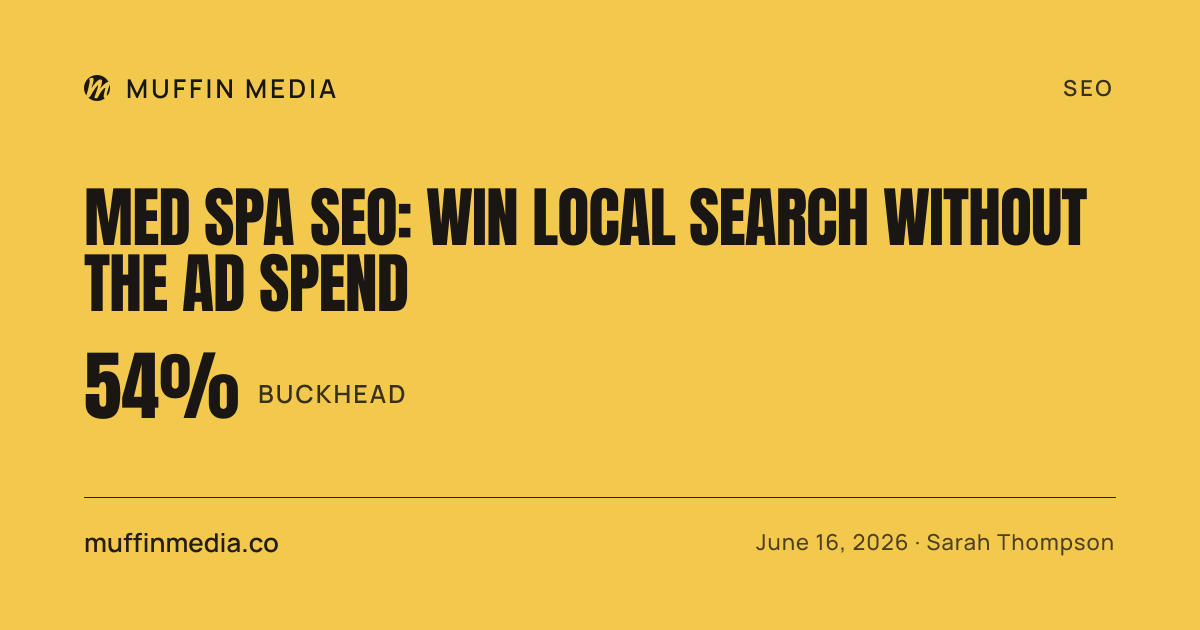
Advertising rates vary more than most operators expect. Across our 10-city pull, the share of spas running any paid advertising ranged from 32% in Stamford to 54% in Buckhead. That means even in the most competitive market we tracked, nearly half of spas are not running ads right now.
Nationally, the picture is even more favorable for content: 62% of med spas have never run a single digital ad. Only 16.5% are actively advertising at the moment we pulled the data, even though 38% have tried at some point.
What does that mean for content? The organic channel is significantly less contested than it appears when you look at paid alone. You are not racing 50 advertisers for the top position on a search results page. You are racing a much smaller group, most of whom are publishing inconsistently if at all.
Our full 2026 med spa advertising research report has the per-city breakdowns if you want to see where your market sits.
What topics should a med spa actually write about?
The education gap. That is the short answer, and it shows up in every city we analyzed.
The messaging across paid ads skews heavily toward discounts, seasonal promotions, and before-and-after results. What is almost completely absent is the "why" behind treatments. Why does RF microneedling work better than a basic facial for skin laxity? Why does a series of three Sculptra sessions outperform a single filler appointment for certain patients? Why does your skin get worse before it gets better after a resurfacing treatment?
That information gap is not just an SEO opportunity. It is a trust-building opportunity. Patients who understand the mechanism behind a treatment show up to consultations more confident, ask better questions, and convert at higher rates. They also cancel less and return for maintenance.
Content topics that consistently work for med spas:
• Treatment comparisons ("Botox vs. Dysport: what is the difference?")
• Protocol explainers ("Why we space your laser sessions six weeks apart")
• Myth-busting pieces ("Is filler reversible? Here is what the research actually says")
• Candidacy guides ("Who is a good candidate for body contouring?")
• Post-care instructions as long-form content ("What to expect after your first HydraFacial")
• Frequently asked questions surfaced from your front desk intake forms
None of these require a production budget. They require a person who knows the treatments and someone who can write.
How does content marketing compare to Google and Meta ads on cost?
Our data shows that med spas run 4.8x more ads on Google than on Meta nationally. Across our 10-city pull, that ratio is 4.9x. In Coral Gables specifically, 100% of advertising spas are on Google with zero on Meta. The channel preference is clear.
The spas spending the most on Google ads are still only renting traffic. One budget freeze and they disappear from page one.
Industry benchmarks put Google CPC for med spa keywords in the $8 to $25 range depending on market and treatment type. Cost per lead via paid search typically runs $40 to $120 for med spa categories, though premium markets and competitive treatments push higher. These are industry-standard ranges, not numbers from our proprietary dataset.
Content marketing has a different cost structure. The upfront investment is higher in time and labor. A thorough treatment guide might take four to six hours to research and write. But once it ranks, the marginal cost per visitor is zero. A post that ranks in position three for a 500-search-per-month term in your city is worth real money over 12 to 24 months, without a single additional dollar in spend.
The honest framing: content is not free. It costs staff time or agency fees. But the unit economics improve every month it stays indexed and ranking, unlike paid where cost and traffic move in lockstep.
For a breakdown of how Google ads work alongside content, see med spa Google ads that work. For the organic side of local visibility, local SEO for med spas covers the technical and content components together.
What kind of content actually ranks for a med spa?
Location-specific content ranks. Generic content does not.
A post titled "What is laser hair removal?" is competing against WebMD, Healthline, and RealSelf, which have domain authority you are not going to out-rank in year one. A post titled "Laser hair removal in Scottsdale: what to expect at your first session" is competing against local med spa sites, most of which are thin on content. That is a winnable race.
Med spa marketing in Scottsdale is a useful reference if you want to see how market-level data applies to a specific city. Similar thinking applies to high-density markets like Buckhead, where our pull found a 54% advertising rate and a correspondingly more competitive paid environment, which makes the organic lane even more attractive.
Longer, more specific content also outperforms short blog posts. Google's own quality guidance consistently rewards depth, first-hand expertise, and demonstrated knowledge of the specific topic. A 1,400-word guide on "who is a candidate for Morpheus8" that covers contraindications, realistic outcomes, and recovery is more valuable to a searcher than a 400-word post that restates the manufacturer's description.
Consistency matters more than volume. Two good articles per month, published for 12 months, will outperform a sprint of 20 articles followed by eight months of silence.
How do I know if my content marketing is working?
Track the metrics that connect to revenue, not just vanity numbers.
Organic sessions from Google Search Console, segmented by page, tell you which articles are actually pulling traffic. Time on page tells you whether visitors are reading or bouncing. Conversion events (form fills, phone calls, booking clicks) tell you whether the traffic converts.
The deeper metric is new patient sourcing. At intake or during the first visit, ask new patients how they found you. A surprising number will say "I found an article you wrote" or "I Googled [treatment] and your blog came up." That is content working.
Content also supports paid campaigns. Spas with strong educational content have an easier time getting Meta and Google ads approved because they can link to compliant informational pages rather than direct-response landing pages with medical claims. Our piece on med spa advertising compliance covers that angle in detail.
The 87% of med spas with active ad accounts that our data classifies as beginner-maturity are running campaigns with no supporting content strategy. That creates a measurable disadvantage: paid traffic lands on thin pages and does not convert. Content and paid work better together than either does alone. See med spa lead generation for how these channels connect at the funnel level.
Frequently asked questions
How long does it take for med spa content marketing to show results?
Most med spa markets are local and relatively low-competition for organic search, so new content can begin ranking within two to four months for lower-difficulty terms. Competitive treatment keywords in dense markets take longer, typically six to nine months for meaningful organic traction. The compounding effect becomes clearly visible at the 12-month mark, when a consistent publishing cadence starts producing measurable organic leads each month. The timeline is slower than paid but the traffic does not turn off when the budget does.
Does content marketing work if I already run Google or Meta ads?
Yes, and the combination tends to outperform either channel alone. Our data shows that 87% of med spas with active ad accounts are at beginner maturity, meaning they are running ads to thin landing pages without supporting educational content. Spas that publish substantive content see better ad Quality Scores on Google, lower CPCs, and higher landing page conversion rates. Content also gives you retargeting audiences that are pre-educated on your treatments, which shortens the sales cycle from paid social. The channels reinforce each other when the content is actually good.
What is the minimum content investment to see results for a med spa?
Two to four substantive pieces per month is enough to build meaningful momentum over a 12-month period. Each piece should be 900 to 1,500 words, focused on a specific treatment or local topic, and written with genuine expertise rather than rewritten manufacturer content. A solo practitioner can manage this with two to three hours of writing per week. Larger practices typically benefit from assigning one staff member to content or budgeting $800 to $2,000 per month for a specialist writer. Below that minimum, results are possible but slower. The constraint is consistency more than volume.
Free tool
See the live ad benchmark for your city
Written by Pranav Mohan, Muffin Media

Want this run on your brief?