In 10 of the most competitive US med spa markets, 41% of your competitors are paying for leads right now.
That number should bother you either way. If you're in the 59% not advertising, you're watching competitors buy the patients you could have. If you're already running ads, you're competing against fewer competitors than you think, and most of them are doing it badly.
This article is built on a live pull of 500 med spas across 10 cities, plus a national dataset of 1,995 practices. No survey responses. No industry estimates. Actual ad account activity, platform by platform, market by market. Here is what it shows about where leads actually come from, why most spas never close the gap, and what a real system looks like.
---
How competitive is the med spa advertising market right now?
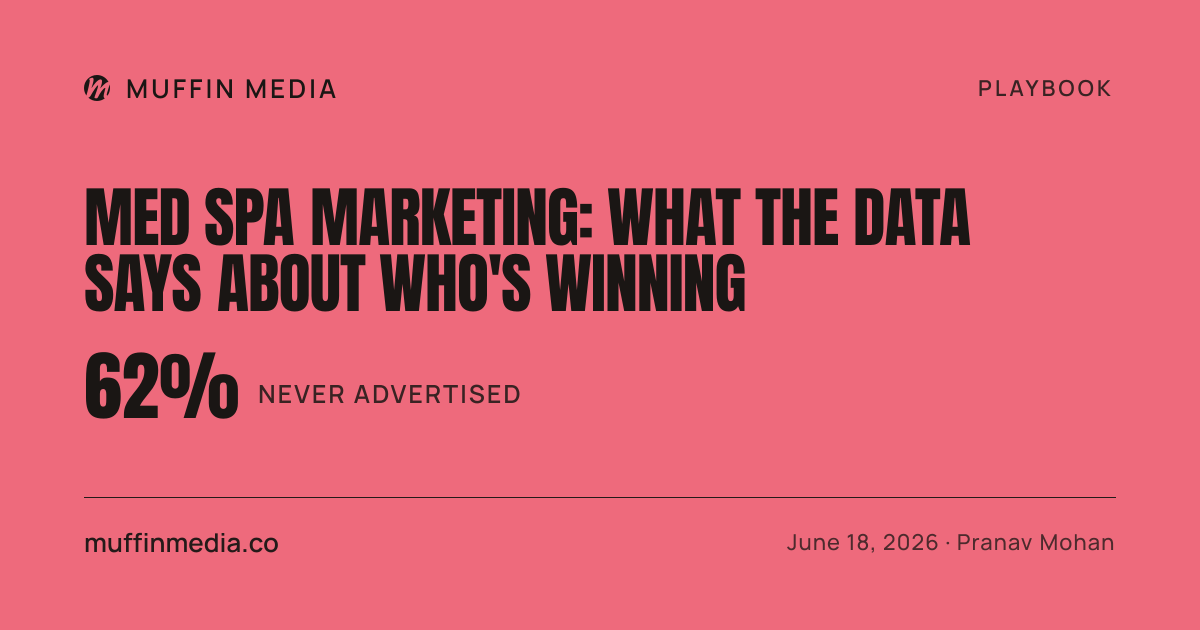
Less competitive than you think. Nationally, 62% of med spas have never run a single digital ad. Even in the ten most active markets we tracked, only 41% are paying for leads at any given time. The remainder are relying on word of mouth, organic search, or nothing.
That creates a real opening. The spas that do advertise are not facing a saturated market. They're fighting over a fraction of the available impression volume, while the majority of the market sits out entirely.
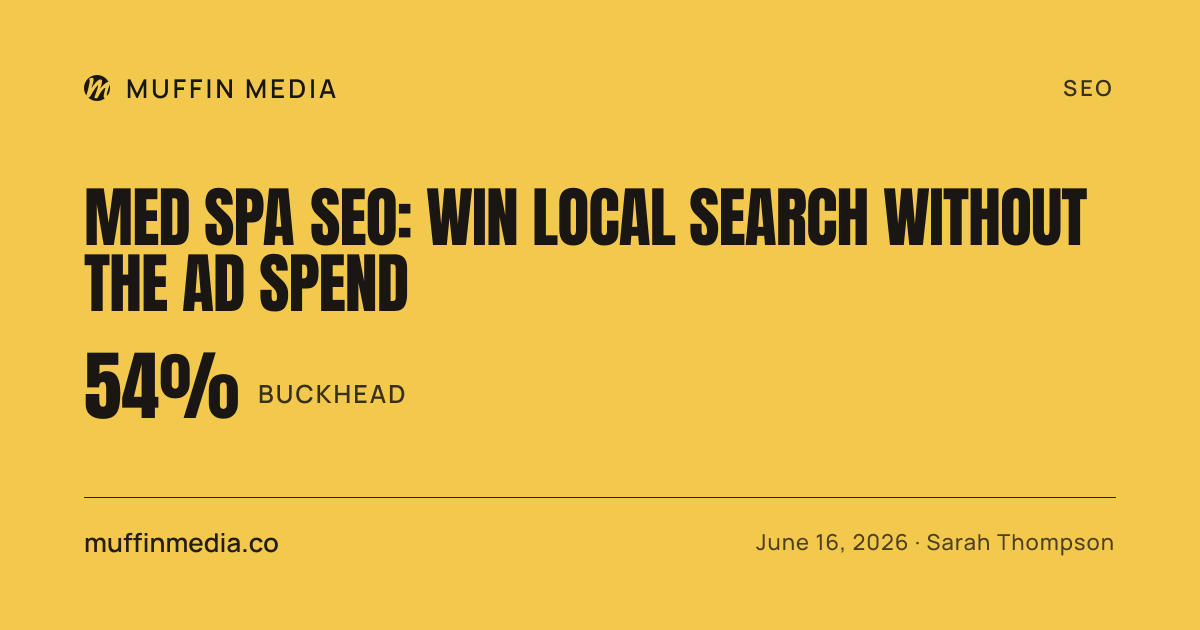
Across the 10 cities, the advertising rate ranges from 32% in Stamford to 54% in Buckhead. Buckhead is the most contested market in the dataset. Even there, nearly half of all practices are invisible to patients searching on Google or scrolling Meta right now.
The national picture is more striking. Only 16.5% of med spas are actively advertising at the time of this pull, though 38% have tried at some point. That means more than half of the practices that ever tested paid ads have since gone dark.
---
Why do so many med spas fail to generate leads consistently?
The answer is not the channel. It's the system, or the absence of one.
Running an ad campaign once, pausing it when the owner gets busy, then restarting it months later is not a lead generation system. It's a spending experiment with no feedback loop. The data confirms this is the norm: 87% of med spas with active ad accounts are classified as beginner maturity. Zero percent are advanced.
That beginner profile looks like this: inconsistent budgets, no conversion tracking, no offer testing, and no relationship between ad spend and patient value. The spas that do stick with it show a different pattern. The average longest-running med spa ad in the dataset has been live for 478 days. One ad has run continuously for 2,886 days. And 42% of spas that have ever advertised keep a campaign running for 180 days or more.
Longevity signals conviction. The spas that stay in the market long enough to learn how their offer converts, which creatives hold attention, and what keywords drive bookings are the ones building a real acquisition machine. The ones that disappear after 60 days never get there.
If you want sustainable med spa lead generation, the first structural decision is committing to a timeline long enough to actually learn something.
---
Should I run Google ads or Meta ads for my med spa?
Google first. The data is not close.
Across the 10-city sample, 167 med spas are running Google ads versus 66 on Meta. That's a 4.9-to-1 ratio. Nationally, med spas run 4.8 times more ads on Google than on Meta. In Coral Gables specifically, 100% of the advertising spas in the market are on Google, with zero on Meta.
The reason is intent. When someone searches "Botox near me" or "laser hair removal in Scottsdale," they've already decided they want the service. They're choosing a provider, not discovering a category. Google captures that demand at the moment it exists. Google ads for med spas convert at higher rates because the patient is already in buying mode.
Meta functions differently. It interrupts. A person scrolling Instagram wasn't looking for a lip filler appointment, but a well-targeted ad can plant the idea and start the consideration process. That makes Meta a brand-building and awareness channel, not a direct-response machine for most practices.
The smart allocation: use Google to close patients who are already searching, and use Meta to build awareness with the audience that will search later. Most med spas currently treat these as either-or options. They're not. They're sequential stages of the same patient journey.
The creative data on Meta is worth noting: video accounts for 41% of ad formats, carousel for 30%, and static image for 29%. If you're on Meta and running nothing but static images, you're using the least-common format. Video and carousel dominate because they show results and create comparison, which is exactly what a patient considering an aesthetic service needs to see.
62% of med spas nationally have never run a single digital ad. The market is wide open for practices willing to show up consistently.
---
What kind of offer actually generates med spa leads?
New-client discounts drive the first appointment. The data shows offers up to 62% off are the common hook across the top-performing spas.
This is not a race to the bottom. The purpose of a new-client offer is to get someone through the door who has never tried your practice. Once they're in, the conversion to a repeat patient, a membership, or an upsell happens through the in-person experience. The front-end discount is the cost of acquisition, not the whole business model.
The practices that sustain this model pair aggressive new-client offers with a clear retention path. There's a detailed breakdown of how that works in med spa memberships and retention, but the short version: a 62%-off intro offer only makes financial sense if a meaningful percentage of those patients rebook.
Your med spa website conversion rate also matters here. An ad can generate a click. If your website doesn't turn that click into a booked appointment, the ad spend is wasted. Most med spa websites underperform because they're designed like brochures, not like booking engines. The landing page needs one job: get the consultation scheduled.
---
How do I know which markets are worth targeting?
Start with where the money is being spent and who's spending it. In Scottsdale, for example, the market has a high concentration of established practices with long-running campaigns. That signals patient demand is real and advertiser willingness to pay is high, which means the cost per click will reflect that competition.
In Stamford, with only 32% of spas advertising, there's less competition but potentially less search volume. Both can work; the math is just different.
The full advertising data by market breaks this down city by city with platform split, advertiser count, and maturity scores. It's the fastest way to benchmark your specific market before you set a budget.
What you're looking for is not the cheapest market. You're looking for the market where your offer has the best chance to convert and where the competitive density doesn't require a massive budget to get visibility. That's often not the most obvious choice.
---
Does local SEO matter if I'm already running paid ads?
Paid and organic are not substitutes. They work together.
A patient who clicks your Google ad and then searches your practice name to validate you before booking will find your Google Business Profile, your reviews, and your website. If any of those look thin or inconsistent, the ad click becomes wasted spend. Local SEO for med spas ensures your organic presence can close the patients your paid ads attract.
Beyond validation, organic traffic from local search generates leads at zero marginal cost per click. Over time, a strong local SEO presence reduces your reliance on paid spend to maintain patient volume. The spas with 478-day average campaign runtimes are not doing that because they love paying for clicks. They're doing it because the economics work and they have the organic foundation to make paid acquisition profitable.
The med spa marketing guide for 2026 covers how the paid and organic channels should be sequenced and what to prioritize based on where your practice is in its growth stage.
One note on compliance: med spa advertising carries specific restrictions around before-and-after imagery, testimonials, and claims. Before you scale spend on any platform, review what's allowed. Getting flagged or banned by a platform mid-campaign is expensive in ways that don't show up in your ad dashboard.
---
This is not theory. We took a med spa from $61 to $19 cost per lead and 5.1x return on ad spend, adding roughly $33,000 in monthly revenue. See the full Focal Point Vitality case study.
Frequently asked questions
How much should a med spa budget for lead generation?
There's no universal number, but the structure matters more than the total. Allocate enough to run a Google campaign continuously for at least 90 days before drawing conclusions, because campaigns need time to exit the learning phase and generate statistically meaningful data. Most practices in the 10-city dataset that stick for 180 days or more arrive at a cost-per-acquisition they can plan around. Starting with a budget that forces you to pause the campaign after three weeks guarantees you will never get there. A rough starting range for a single-market Google campaign is $2,000 to $4,000 per month, adjusted up in higher-competition cities where CPCs are elevated.
What is the biggest mistake med spas make with paid ads?
Treating a campaign as a one-time test rather than an ongoing system. The data shows 87% of active med spa advertisers are at beginner maturity, and the most common pattern is to run a brief burst of spend, see inconsistent results, and stop. The spas with the longest-running campaigns, some north of 2,800 days continuous, didn't achieve profitability in week one. They iterated on offers, landing pages, and targeting until the economics worked, then scaled. Stopping before that iteration happens means you paid for the learning but never collected the returns.
Is Meta advertising worth it for a med spa?
Meta is worth it as a second channel, not a first. The platform-split data makes this clear: 167 Google advertisers versus 66 Meta in the 10-city sample, a nearly 5-to-1 ratio, because search intent converts more predictably than social interruption. That said, Meta has a role. Video creative showing real results, carousel ads comparing treatment options, and audience targeting based on demographics and interest signals can build awareness that feeds Google search volume over time. If your budget forces a choice, start with Google. If you have room for both, Meta works best when it's handled as a brand-awareness layer with its own creative strategy, not as a second Google campaign with different targeting.
Free tool
See the live ad benchmark for your city
Written by Sarah Thompson, Muffin Media

Want this run on your brief?