For every one med spa ad on Instagram or Facebook, nearly five are running on Google. That ratio holds across a national dataset of 1,995 med spas, and it gets more pronounced in specific markets. If your ad strategy centers on Meta, you are playing on the smaller field.
This is not conventional wisdom. Most med spa owners assume Instagram is where patients discover aesthetics treatments. The data says otherwise. Understanding why changes how you should allocate your budget, your creative energy, and your time.
The numbers come from a live ad pull across 10 cities and a national sample of 1,995 spas tracked through mid-2026. We are looking at who is actually advertising, on which platforms, for how long, and at what level of sophistication. The results are summarized in our full data report.
Which platform should a med spa actually advertise on?
Google is the dominant paid channel, and it is not close. Nationally, 226 med spas are active Google advertisers compared to 142 on Meta, inside the 1,995-spa dataset. Across the 10-city pull of 500 spas, that gap widens: 167 Google advertisers versus 66 on Meta, a 4.9x ratio.
The reason is intent. Someone searching "Botox near me" or "lip filler [city]" is already in buying mode. Google Search captures that demand at the moment it exists. Meta surfaces ads to people who may or may not be thinking about aesthetics treatments right now, which makes it a harder conversion path and a longer sales cycle.
That said, Meta is not useless. It is simply a different tool. The format data shows Meta leans visual: video 41%, carousel 30%, image 29%. Those formats work for awareness and brand recall, not same-week bookings. A Google-first budget with selective Meta retargeting is the architecture that the volume data points toward.
For a deeper look at how search intent plays into this, see our guide to med spa Google Ads that work.
How many med spas are actually running ads right now?
Only 16.5% of med spas are advertising at this moment. That is a narrow slice of the market, and it reveals an enormous gap for any practice willing to stay in the game consistently.
Zoom out slightly and the picture shifts: 38% of med spas have run at least one digital ad at some point. The difference between 38% who tried and 16.5% who are active is the group that quit. They turned ads on, did not see an instant return, and turned them off. That is the behavior pattern the data captures everywhere in this dataset.
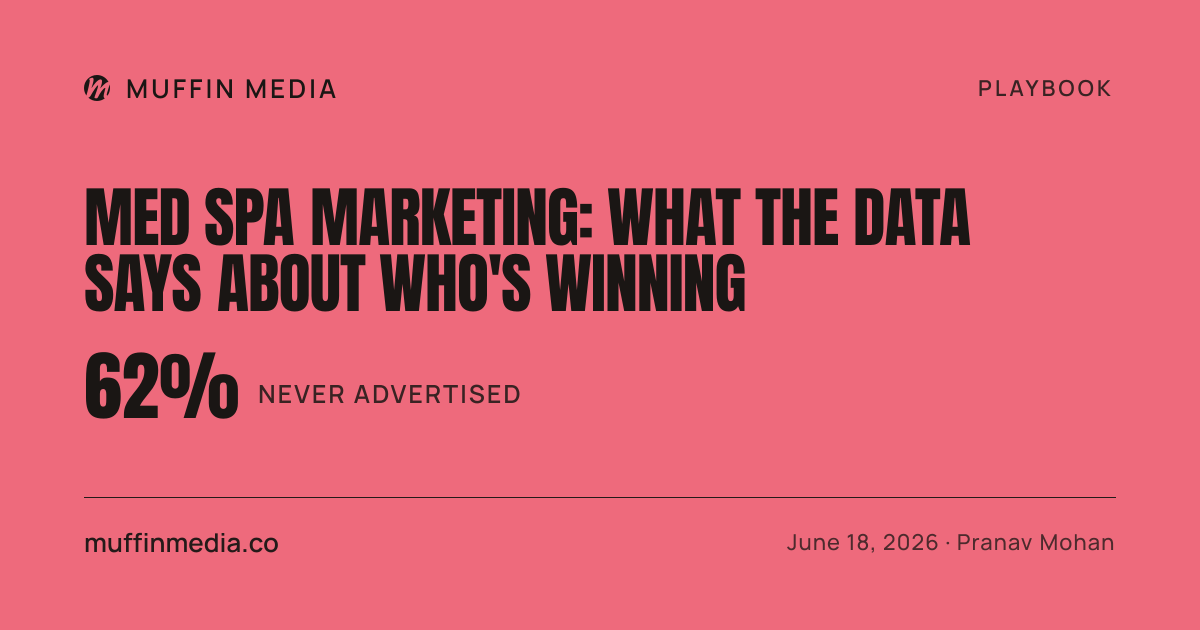
62% of med spas nationwide have never run a single digital ad. Not one campaign. That means nearly two-thirds of your competitive market is entirely invisible in paid channels. If you are willing to advertise consistently, you are competing against a much smaller pool than the total number of spas in your area.
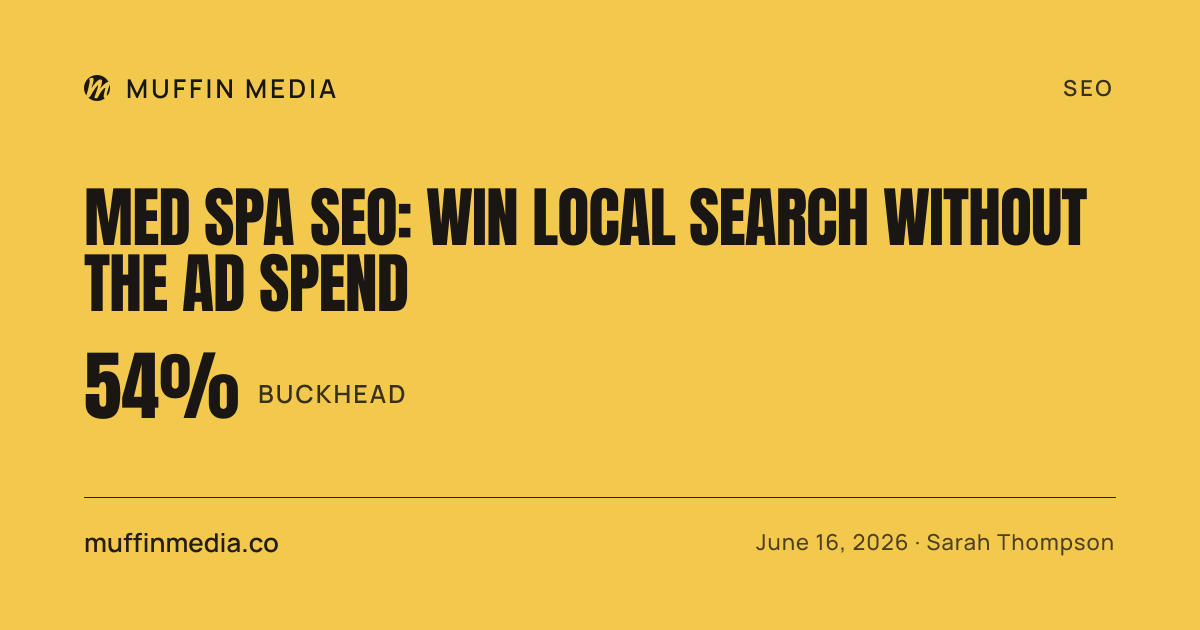
City-level advertising rates range from 32% in Stamford to 54% in Buckhead, which means even the most saturated market still has nearly half its spas sitting out. In most cities, the majority of spas are not advertising at all. Buckhead is one of the more competitive markets, which makes the 54% rate a useful benchmark for what "active" looks like in a dense urban corridor.
Why do most med spa ad campaigns fail?
They stop too soon. The average longest-running med spa ad in our dataset runs 478 days. The maximum observed is 2,886 days, nearly eight years. These are not seasonal promotions. These are always-on campaigns that compound over time.
The average winning med spa ad runs for 478 days. Most spas pull the plug in weeks.
Only 42% of med spas that have ever advertised keep a campaign running 180 days or longer. The rest treat advertising like a faucet: turn it on when bookings are slow, turn it off when things get busy, and wonder why the results are inconsistent. That stop-start behavior destroys quality scores on Google, resets audience learning on Meta, and guarantees you never accumulate the data needed to optimize properly.
The spas with the longest-running ads are not necessarily spending the most. They are just not stopping. Consistency is the variable that separates the operators who see compounding returns from the ones who conclude "ads don't work for us."
This connects directly to med spa lead generation strategy. Practices that treat paid search as an always-on acquisition channel, rather than a burst tactic, build a lead pipeline that smooths out the seasonal swings that kill smaller practices.
What does the sophistication gap look like?
It is stark. 87% of med spas with active ad accounts are classified as beginner-maturity. Zero percent are advanced. That means the bar to outperform your local competition on paid channels is actually low, because almost nobody is running optimized campaigns.
Beginner-maturity typically means: one or two ad groups, broad keywords, no conversion tracking beyond phone calls, no remarketing, no negative keyword lists. These accounts spend money and generate some results, but they leave most of the budget efficiency on the table.
Advanced accounts run tightly themed ad groups per service, track form fills and booked appointments as conversion events, layer in remarketing to past site visitors, use automated bidding strategies that optimize toward booked consults, and test creative systematically. Almost no med spa is doing this. The competitive advantage available to a practice willing to run sophisticated campaigns is larger than in almost any other local services category.
For context on what compliance guardrails apply when running these campaigns, our med spa advertising compliance guide covers the FDA and FTC rules that affect before/after imagery and treatment claims.
Does the platform split look different in specific cities?
Yes, and Coral Gables is the clearest example. In that market, 100% of advertising med spas are running on Google. Zero are on Meta. The entire competitive battle in that city is happening on search.
That kind of market-level data matters because your local advertising strategy should reflect what your actual competitors are doing in your specific geography, not a national average. A spa in Buckhead is operating in a different competitive environment than one in Stamford, where only 32% of spas advertise at all.
The 10-city pull gives us a live view of those local dynamics. In Scottsdale, for example, the aesthetic market skews toward high-frequency Google presence because patient intent searches in that area are dense and predictable. Local SEO for med spas and paid search work together there, where organic and paid listings reinforce each other for the same high-intent queries.
What budget and creative approach does the data support?
The data does not tell you what to spend, but it tells you how to structure the spend. Google-first, Meta-secondary, always-on rather than burst-and-pause.
On creative, the Meta format split, video 41%, carousel 30%, image 29%, tells you that video content is the dominant unit even if Meta is the secondary channel. If you are going to run Meta at all, you need video. Static images are the smallest share of what is actually in market.
On Google, the length of winning campaigns points to one thing: budget continuity. A Google Search campaign cannot optimize in three weeks. It needs months of conversion data before automated bidding strategies can find the right patients at the right cost. The 478-day average is not an accident. It reflects how long it actually takes for a well-built campaign to reach its performance ceiling.
This compounds with everything else in the med spa marketing guide for 2026. Paid search feeds your lead pipeline, which feeds your retention programs, which feeds your review volume, which feeds your organic rankings. Each piece reinforces the others, but only if the paid traffic is consistent enough to seed the system.
From a website standpoint, campaigns only work as well as the landing page they send traffic to. Our breakdown of med spa website conversion covers what the highest-converting pages in this category actually include.
This is not theory. We cut a two-location med spa's cost per lead from $47 to $18 and lifted return on ad spend to 4.6x, tracked to booked consultations rather than clicks. See the full Beverly Hills Rejuvenation Center case study.
Frequently asked questions
Is Google or Instagram better for med spa advertising?
Google outperforms Meta by nearly 5x on active advertiser volume in a national sample of 1,995 med spas, with 226 active Google advertisers versus 142 on Meta. The reason is purchase intent: people searching for specific treatments are ready to book, while social media audiences require more nurturing. A Google-first strategy, supplemented with Meta video for awareness and retargeting, reflects what the actual advertising data shows working in this market.
How long does it take for med spa ads to work?
The data suggests months, not weeks. The average longest-running med spa ad runs 478 days, and only 42% of spas that ever advertised maintain a campaign past 180 days. Google campaigns in particular need time to accumulate conversion data before automated bidding can optimize toward your best patients. Practices that stop campaigns inside the first 60 to 90 days are making decisions before the system has enough signal to perform. Consistency is the primary variable separating profitable campaigns from failed ones.
What percentage of med spas in my area are advertising online?
Nationally, only 16.5% of med spas are actively advertising right now, and 62% have never run a digital ad. City-level rates in our 10-city pull range from 32% in Stamford to 54% in Buckhead. Even in the most active markets, nearly half the competitive set is sitting out paid advertising entirely. That gap represents a significant opportunity for practices willing to build a consistent, long-term paid search presence while competitors stay offline.
Free tool
See the live ad benchmark for your city
Written by Sarah Thompson, Muffin Media

Want this run on your brief?