Prop firms make money on evaluation fees before anyone gets funded, and the ad data proves it: the category runs on trader acquisition at industrial scale.
That single fact reframes almost everything else about the business. A prop firm's core product is not, at the revenue level, funded trading capital. It is the evaluation itself, sold as a product with its own pricing and its own repeat-purchase logic. Funded accounts and profit splits are the story the marketing tells. The challenge fee is the business paying its bills. To understand why nearly two-thirds of these firms run continuous ad campaigns, and why one firm alone accounts for most of the ads you will see in the category, you have to start with how the money actually moves.
We pulled ad data on 126 prop trading firms through Muffin Intel to see what the advertising says about the business underneath it. The short version: the funnel never stops, because it cannot afford to.
How do prop firms make money before a single trade goes live?
Prop firms collect their most reliable revenue from the evaluation fee, a one-time charge a trader pays for the chance to prove they can trade within a set of rules. Depending on the account size and firm, that fee typically runs from roughly fifty dollars for a small account up to several hundred dollars, or more, for larger buying power. The trader gets a demo or simulated account, a profit target, a maximum drawdown, and a time window. Pass the test and, in theory, the firm funds the account. Fail, and the fee is gone.
This is the part that gets underemphasized in most explainers: the fee is charged whether or not the trader ever sees a dollar of funded capital. It covers the platform, the data feed, the support staff, and the marketing that brought the trader in the door in the first place. None of that depends on trading outcomes. A firm with enough challenge volume can run profitably even if it funds very few accounts, because the challenge itself is the transaction, not a formality before the real one.
What happens to the traders who do not pass?
Most people who buy an evaluation do not finish it with a funded account, and that outcome is built into the model rather than being an unfortunate side effect of it. Profit targets paired with daily and overall drawdown limits are designed to filter for consistency under pressure, which is a genuinely hard thing to demonstrate over a short window. Firms are open about the rules; they are rarely as open about how often those rules actually get cleared.
Where the model gets its second wind is the reset. Many firms sell a discounted retry to traders who breach a drawdown rule partway through, rather than making them buy a fresh evaluation at full price. That reset purchase is revenue from a customer who was already acquired once, at a lower incremental cost to the firm than the original ad spend that brought them in. It is a sensible business move. It also means a large share of category revenue can come from repeat attempts rather than first-time buyers, which is worth knowing before treating a challenge purchase as a single, contained cost.
What does a funded account actually pay the trader, and the firm?
Once a trader passes, the standard structure is a profit split, commonly marketed in the 80/20 to 90/10 range in the trader's favor, applied to whatever the account earns going forward. The firm keeps the account, sets scaling rules for growing or shrinking it based on performance, and in many cases manages risk on its own book rather than routing every funded trader's orders into a live market at full size. The specifics vary firm to firm and are usually in the fine print, not the ad.
The number worth sitting with is not the split percentage. It is the base it applies to. A generous split sounds like the whole offer, but it only pays out to traders who both pass the evaluation and then trade profitably enough, consistently enough, to clear a payout threshold. That is a smaller group than the number of people who bought the challenge in the first place, by definition. The profit split is the headline. The evaluation fee is the revenue that arrives regardless of whether that headline ever gets cashed.
The evaluation fee is the business. Funded trading is what gets marketed.
Why does this model depend on constant new trader acquisition?
Because the fee is the certain revenue and the funded payout is the contingent one, so the business only grows if new challenge buyers keep showing up faster than existing ones churn out through failure, resets, or eventual funded payouts. A firm cannot lean on its funded-trader base the way a subscription business leans on renewals, since a meaningful share of that base is, by design, temporary. Growth means top-of-funnel volume. Top-of-funnel volume means marketing. And marketing, in this category, means advertising at a scale that shows up clearly the moment you look at who is actually running ads.
What does the ad data reveal about how prop firms actually operate?
The advertising behavior across the category lines up with the funnel almost exactly: most firms buy ads, and they buy them on the channel built for reaching people who are not yet customers. Of the 126 prop trading firms in the Muffin Intel dataset, 78, or 62 percent, run paid ads somewhere. The other 48 are dark, meaning no detectable ad presence at all, which likely means they are leaning on affiliates, influencers, or organic community reach instead of paid acquisition.
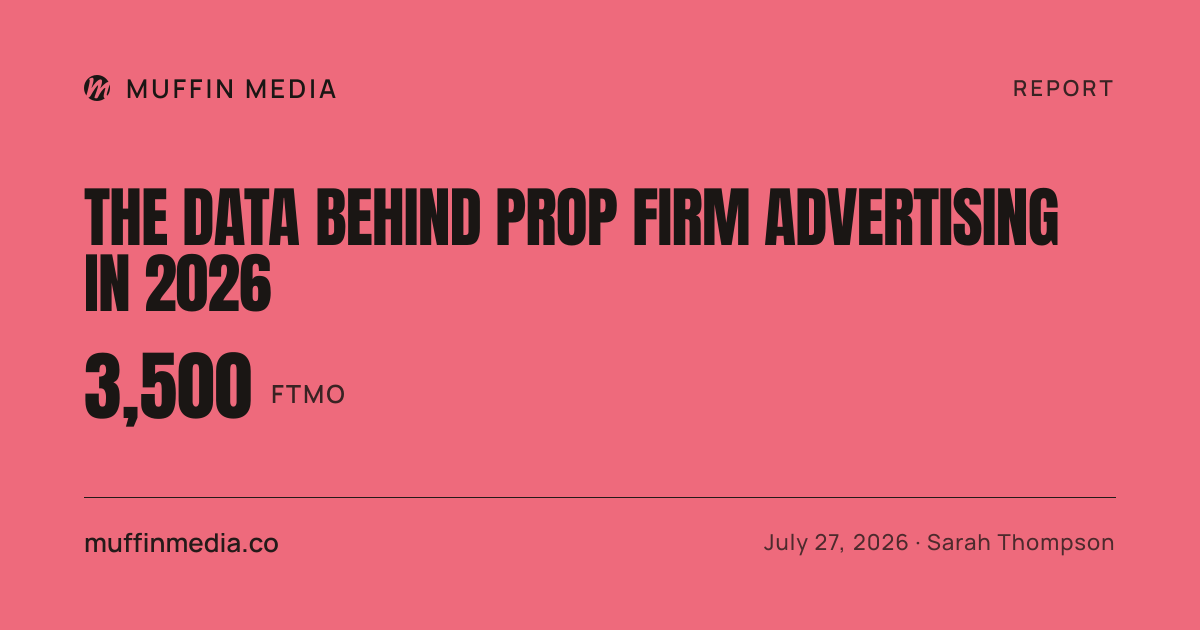
Google is the broad channel for this category: all 78 advertisers run ads there, largely capturing people already searching for a firm by name or comparing options. Meta is a different story entirely. Only 15 firms run Meta ads, and every one of them also runs Google, meaning Meta is an addition for firms with real acquisition budgets rather than a substitute for search. And Meta is where the category gets genuinely lopsided: there are 4,875 live Meta ads running across these firms at any given time, and FTMO alone runs 3,500 of them, 72 percent of all Meta ad volume in the category. Add FundedNext and two firms account for 90 percent of everything running on Meta. This is not a fragmented market fighting for attention on even terms. It is one firm outspending an entire industry, and a second firm a distant way behind it.
What are prop firms actually telling traders to get them to click?
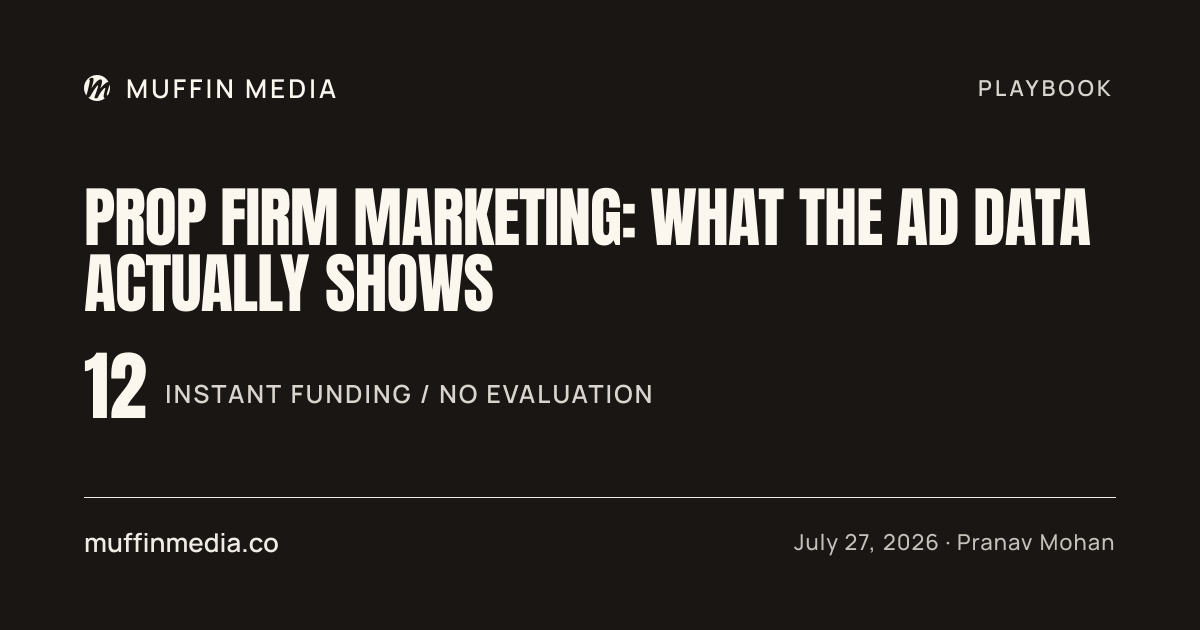
The ad angles cluster around removing hesitation rather than explaining economics. Across the firms running paid creative, instant funding or no-evaluation offers appear in 12 firms' campaigns, and get-funded or capital-size framing, the promise of trading with a large account, appears in another 12. Fast payouts show up in 5 firms' ads, and profit split framing, the number that is technically the headline benefit, appears in only 3. The angle that wins is not the one that explains what a trader actually keeps. It is the one that shortens the distance between seeing the ad and buying the challenge.
That pattern matters if you are reading this from the operator side rather than the trader side. The economics above are exactly why so many new firms have entered this space in the past few years, and why so much of the competitive fight happens in acquisition rather than product. If you are weighing whether to build in this category, our guide to starting a prop firm and our breakdown of white-label prop firm technology providers cover the operational side of that decision. For the fuller picture of how the category advertises, our full report on prop firm advertising breaks down all 126 firms firm by firm, and our prop firm marketing hub collects the rest of what we have published on the category.
Should any of this change how you think about buying a challenge?
This piece is business and marketing analysis, not trading or financial advice, and nothing here should be read as a recommendation to buy an evaluation or to trade with any firm. What the model and the ad data together make clear is that the economics favor the firm collecting the fee, and that most people who buy a challenge do not walk away with a funded, paying account. That is not an accusation that the category is dishonest. It is what a fee-funded acquisition model looks like when you trace the money instead of reading the marketing. If you are considering a challenge, treat the fee as a real cost with real odds against you, read the specific firm's rules in full, and make the decision with that framing rather than the one in the ad.
Frequently asked questions
Do prop firms make money even when traders never get funded?
Yes. The evaluation fee is charged and kept regardless of whether the trader passes, and it functions as the firm's primary, reliable revenue line. Funded-account profit splits sit behind it as a smaller, slower, and less certain revenue stream that only materializes for the traders who pass and then trade profitably enough to earn a payout.
What percentage of prop firm traders actually pass the challenge?
There is no single verified figure across the industry, and pass rates vary by firm, account size, and challenge rules, so treat any specific number you see quoted with caution. What is consistently true across firms is that passing is described as the exception rather than the norm, which is why resets and repeat attempts are a normal, marketed part of the purchase flow rather than an edge case.
Is buying a prop firm challenge worth it?
That is a personal financial decision this article is not positioned to make for you, and it deserves independent research into the specific firm's rules, fee, and payout terms rather than a general answer. What is worth carrying into that research is the economics covered here: the fee is collected up front regardless of outcome, and the funded, paid-out result that gets marketed applies to a minority of challenge buyers, not the average one.
Free
See what your market is advertising
Written by Aditya Mohan, Muffin Media

Want this run on your brief?