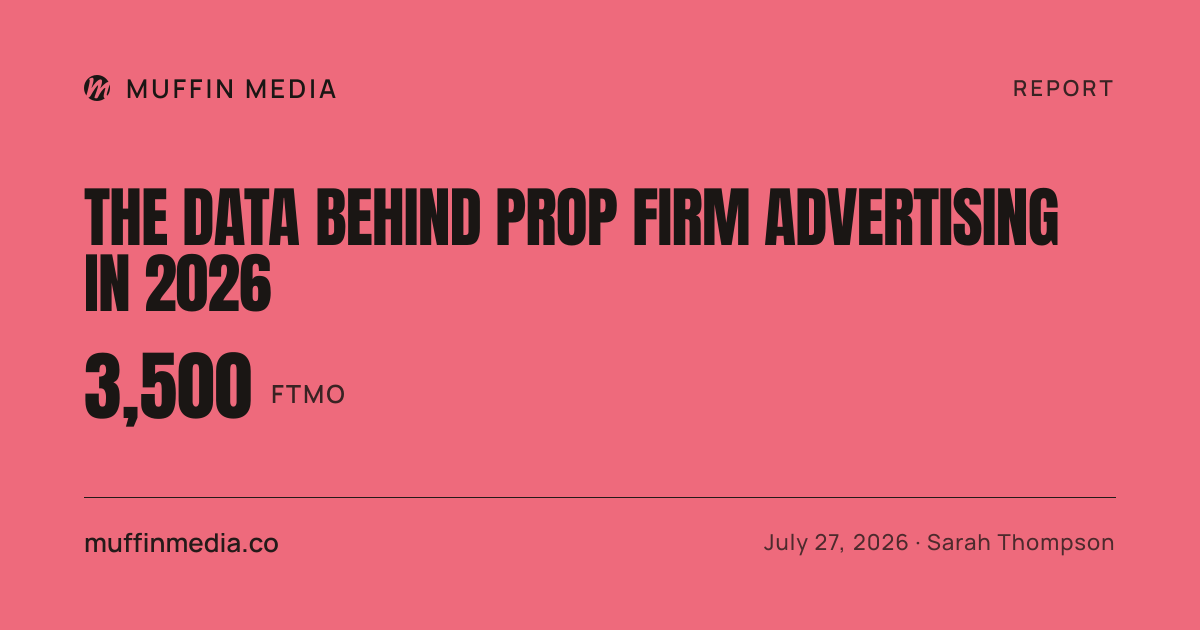
Starting a prop firm is easier than ever. White-label trading platforms are mature, payment processors have handled funded-trader payouts for years, and a challenge can go live in weeks rather than months. Getting traders is the hard part: you launch against FTMO's 3,500 live ads.
That is not a rhetorical flourish. It is a count. Muffin Intel tracked 126 prop trading firms across Google and Meta, and the picture is stark. Seventy-eight of them, 62%, run paid ads somewhere right now. Forty-eight show nothing measurable at all. Among the 78 that do advertise, Meta is where the real crowding happens: only 15 firms run Meta ads, and every single one of them also runs Google. FTMO alone accounts for 3,500 of the roughly 4,875 live Meta ads in the category, 72% of all category inventory. Add FundedNext's 870 and two firms hold 90% of the ad space every prospective trader scrolls past.
What does it actually take to start a prop firm?
At a functional level, four pieces need to exist before you sell your first challenge: a pricing and evaluation model, a trading platform your traders will actually use, a payout and compliance layer, and a way to get people through the door. None of these are hard to source anymore. Evaluation logic runs on top of MetaTrader, cTrader, or DXtrade through a handful of white-label vendors who have already solved risk monitoring, breach detection, and trader dashboards. Payouts run through payment processors and crypto rails that are used to the rhythm of funded-trader withdrawals. KYC and AML checks plug in through the same identity vendors fintechs use. The technical build is now closer to configuration than engineering.
What is not solved for you is demand. A firm can be live, compliant, and fully funded, and still fail to acquire traders, because the acquisition side of the business is where the category's actual competition sits. That is the part this guide spends the most time on.
Build your own platform or go white-label?
For a first firm, white-label is the right default. A licensed platform gets you evaluation logic, a trading terminal, and risk controls in weeks, and it lets you spend your first year learning what your traders actually want instead of debugging a matching engine. Building your own stack makes sense later, once you have volume that justifies the engineering cost and you understand your own risk model well enough to own it end to end. Founders who build first usually do it because they underestimate how much of the hard work is acquisition, not infrastructure. We cover the tradeoffs of each path, including where the margin actually sits, in our white-label prop firm guide.
The decision that matters more than platform choice is your risk model: whether you are running traders against a real aggregated book, a synthetic internal book, or some blend of both. That choice shapes your payout obligations, your regulatory exposure, and your unit economics more than any vendor selection does.
How much capital do you actually need to launch?
Budget for three buckets, and expect the third to be the one that surprises you: platform and licensing costs that recur monthly regardless of how many traders you sign, a payout reserve that has to cover an unpredictable pass rate because you do not control how many traders clear an evaluation in any given month, and customer acquisition spend. Industry conversations put challenge economics on a knife's edge: most firms rely on the spread between challenge fees and the smaller share of traders who actually pass and get paid, so a founder who underprices acquisition risk can look profitable on paper and still run out of cash covering payouts. For the mechanics of how that revenue model actually works, see our breakdown of how prop firms make money.
The acquisition line is the one most founders budget last and pay for first. You are entering a market where 62% of competitors already advertise and one firm has effectively priced Meta out of reach for a newcomer trying to match its share of voice. Your capital plan needs to assume you will not outspend FTMO, because you cannot, and build the marketing budget around a narrower, cheaper bet instead.
What regulatory flags should you watch before you launch?
The first flag is your own product description: firms that promise real capital and real profit splits face a different regulatory conversation than firms that are transparent about running a simulated evaluation against an internal book. Regulators in a handful of jurisdictions, including securities and derivatives regulators, have started asking prop firms to clarify exactly which of those two models they run, and marketing copy that blurs the line invites scrutiny that a clear disclosure avoids. The second flag is payment processing: prop firm payouts sit in a risk category that some processors flag on sight, so onboarding with a processor who already understands the model saves months. The third is jurisdiction. Where you incorporate, where your processor is domiciled, and where your traders live do not have to match, but the mismatch has to be handled deliberately rather than discovered after a bank freezes your account.
None of this is a reason to delay launch. It is a reason to write your terms and your marketing claims with a lawyer who has seen a prop firm before you write your first ad.
Where will your traders actually come from?
Three channels produce real traders: trading communities and forums, affiliate relationships with trading YouTubers and Discord educators, and paid social. Paid social is where the category actually fights, and the fight is more concentrated than it looks from the outside. Google is the broad channel, with 78 firms running search and display ads there. Meta is the narrow one: only 15 firms bother, and the reason is simple. FTMO and FundedNext already own 90% of the live inventory, so a newcomer buying Meta ads is bidding against a competitor who can outspend them ten times over on the same audience.
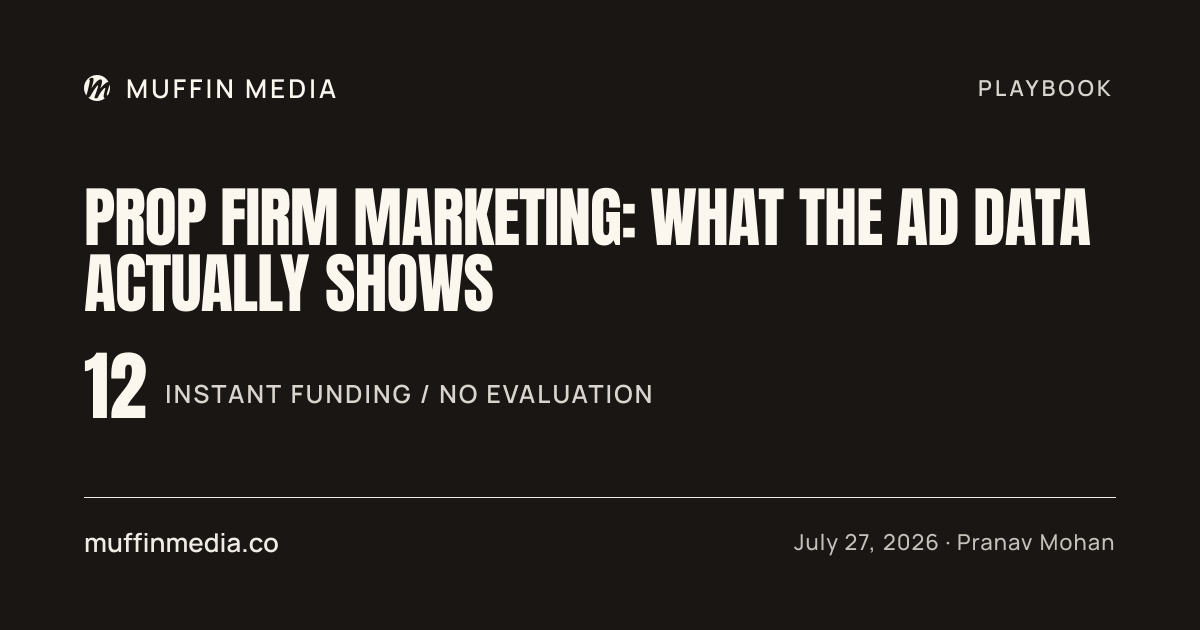
The message field is just as concentrated as the spend. Across the category, two angles dominate the ad copy: instant funding or no evaluation, and get funded on a large capital size. Twelve firms run each. Fast payouts shows up in five firms' copy, profit split messaging in three, and angles built around a specific asset class in just two. That last number is the interesting one. A category with 78 active advertisers and only two of them narrowing their pitch to a specific asset class is a category where almost everyone is saying the same thing to the same audience.
Your wedge is a differentiated angle, not spend.
What's your wedge if you can't outspend FTMO?
You do not need to win the auction. You need to say something the auction is not saying. With two angles accounting for most of the category's ad copy, a founder who picks an underused position, an asset-class specialty, a genuinely different payout structure, a service angle nobody else is running, gets found by a smaller but more qualified audience instead of fighting FTMO for the same forty-year-old options trader scrolling Instagram. This is a copy and targeting problem before it is a budget problem. A firm with a clear, narrow promise beats a firm with a bigger budget and a generic one, at least until the narrow position gets crowded too.
That is also the argument for building your acquisition strategy around actual competitive intelligence rather than guesswork. Knowing which 12 firms are already running the instant-funding angle, which 15 are even on Meta, and which channels the 48 dark firms are missing entirely tells you where the open ground is before you spend a dollar finding out the hard way. That is the work we do for prop firms and the rest of the category inside our broader prop firm marketing coverage, and it starts with the same public ad-library data behind every number in this guide, laid out in full in our state of prop firm advertising report.
Frequently asked questions
Is starting a prop firm still worth it in 2026?
The operational barriers are lower than they have ever been, but so is the differentiation between firms, since most of the category runs the same white-label platforms and the same two ad angles. Firms that treat marketing as an afterthought are entering a market where 62% of competitors already advertise and one competitor controls most of the visible ad space, so the honest answer depends less on the trading model and more on whether you have a distribution plan before you launch.
Do I need a broker license to run a prop firm?
It depends on your risk model, not on the fact that you are calling yourself a prop firm. A firm running traders on real capital through a regulated broker relationship faces different licensing questions than a firm running simulated evaluations against an internal book, and the honest path is to get that classification confirmed by counsel in your jurisdiction before you write a single marketing claim, not after a regulator asks.
How long does a white-label prop firm take to launch?
Most founders using an established white-label vendor can have a challenge live within a few weeks, since the platform, risk monitoring, and payout rails are already built and mostly need configuration rather than development. The part that takes longer, and the part most founders underestimate, is building an acquisition channel that can compete in a category where 78 of 126 tracked firms are already advertising.
Free
See what your market is advertising
Written by Sarah Thompson, Muffin Media

Want this run on your brief?