A white label gets you a prop firm in weeks. It also gets you the exact same pitch as everyone else, in a category drowning in it.
That tradeoff is the entire decision, and most operators only see half of it. They see the speed: a licensed platform, a payment processor already in place, a risk engine someone else built and tested. What they don't see until they're live is the message they've bought into. Muffin Intel tracked ad activity across 126 prop trading firms, and the pattern in that data is the part white label vendors don't put in the pitch deck. This article walks through what a white label actually is, what it costs against building from zero, and the marketing problem baked into the model before you send your first dollar to Meta or Google.
What is a white label prop firm, exactly?
A white label prop firm is a brand you put on someone else's infrastructure. You supply the name, the domain, the marketing, and usually the trading rules and payout structure, while a backend provider supplies the platform, the liquidity connections, the risk monitoring, and often the payment rails. The provider has already done the hard regulatory and technical legwork across a roster of other brands running on the same stack. You're renting proven plumbing so you can focus on getting traders in the door.
This is different from a full reseller arrangement, where you're mostly just running someone else's challenges under your logo with little control over rules or pricing. A proper white label gives you room to set your own challenge structure, profit splits, and payout terms, within the limits the backend platform allows. The appeal is obvious for anyone who wants to test the category without spending a year and a large balance sheet on infrastructure first.
What does a white label actually cost, and how fast is it?
Cost and timeline are the two variables every operator asks about first, and they move in opposite directions from building it yourself. Industry conversations around white label setup put the entry cost anywhere from the low tens of thousands into six figures, depending on how much platform customization, liquidity access, and brand support you're buying, with most providers quoting a live launch inside four to eight weeks once contracts are signed.
That number is a range, not a guarantee, and it typically covers setup and licensing rather than marketing. Ongoing costs run on top: a monthly platform fee, a revenue share back to the provider on challenge sales, and payment processing charges that in this category tend to sit higher than typical ecommerce due to chargeback risk. None of these figures are ours to report as fact. They're the ranges operators in this space describe when comparing providers, and they vary enough between vendors that a founder should get three quotes before assuming any single number.
How does white label compare to building your own prop firm from scratch?
Building from scratch trades speed for control, and the gap between the two paths is wider than most first-time founders expect. A ground-up build means negotiating your own liquidity provider relationships, securing payment processing that will actually tolerate a prop trading business model, building or licensing a trading platform, and designing a risk and payout system from zero. Industry timelines for that path commonly run six to twelve months before a firm can responsibly onboard its first funded trader, and the upfront investment is substantially higher than a white label entry fee.
What you get for that time is a business that isn't structurally identical to forty other brands. You set your own risk parameters, you're not exposed if your backend provider has a liquidity event or a policy change, and your margins aren't shared with a platform partner in perpetuity. For a founder with capital and patience, that independence compounds. For a founder who wants to test demand before committing years, white label is the only realistic entry point, and that's exactly why so many brands in this category share a backend.
What's the marketing catch white label firms don't tell you about?
The catch is that a shared backend usually means a shared message, and the data on this category is unusually stark. Across the 126 prop trading firms Muffin Intel tracked, 78, or 62%, run paid ads and 48 are dark on paid channels entirely. Google is the broad channel: all 78 advertisers run search or display there. Meta is a different story. Only 15 firms run Meta ads at all, and every one of them also runs Google, meaning Meta is additive spend for firms that are already advertising elsewhere, not an alternative entry point.
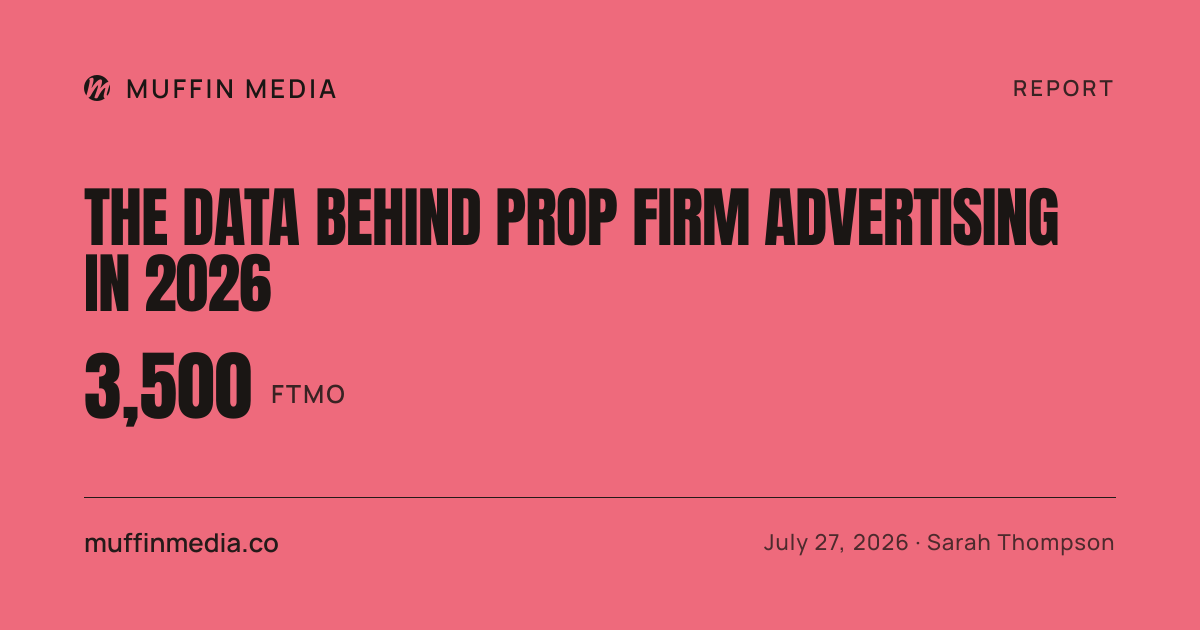
Meta is also winner-take-all in a way that should concern any new entrant. There are 4,875 live Meta ads running across the category right now, and FTMO alone accounts for 3,500 of them, 72% of all category volume. Add FundedNext's 870 and two firms control 90% of every live Meta ad in prop trading. Behind them, Fintokei runs 120 ads, RebelsFunding 87, Crypto Fund Trader 85, Darwinex Zero 70, Alpha Capital Group 49, and TradeDay 42.
A white label gets you the plumbing. It doesn't get you a reason for a trader to pick you over the firm running 3,500 ads next to yours.
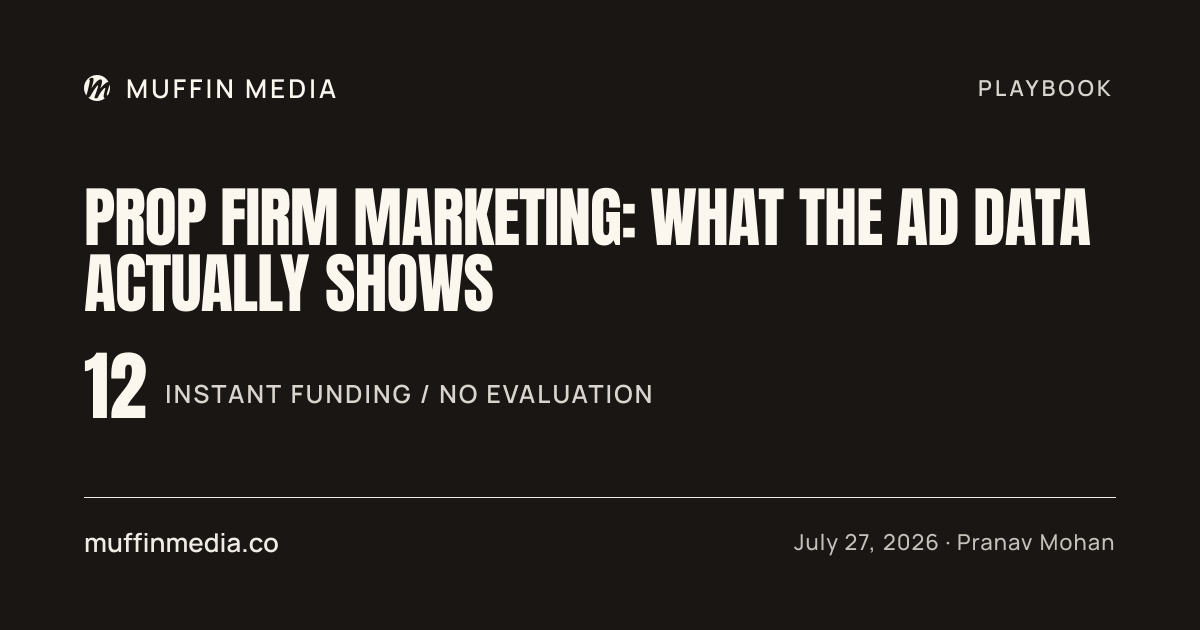
The angles behind those ads are just as concentrated. Twelve firms lead with instant funding or no-evaluation offers, twelve lead with get-funded or capital-size claims, five push fast payouts, three lead on profit split, and two go asset-class specific. Instant funding and get funded together account for 24 of the 35 advertisers we analyzed by angle, which means most of the category's ad copy is fighting over two ideas. A white label doesn't fix that. It puts you on the same rulebook, often the same evaluation structure, as the brands already running that copy, so your ad has to say something different using materially the same product underneath.
Where do white label firms actually need to differentiate?
Differentiation has to happen in message and channel choice, not in backend features that are largely shared across the category. With 63 firms advertising on Google and only 15 on Meta, there's a real gap in a channel most competitors haven't touched, and it's worth testing before assuming Meta's crowding rules you out. The message gap is more urgent: with two-thirds of tracked ad copy split between "instant funding" and "get funded," a white label brand that leads with payout speed, a specific asset class, or a support experience competitors don't mention has room most of the category is ignoring.
This is also where an operator's own read of the competitive field matters more than the backend provider's talking points, since the provider sells the same platform story to every brand it signs. Positioning work belongs in your hands, and it starts with knowing exactly what the 78 active advertisers in this category are already saying, not guessing at it. Our breakdown of the full state of prop firm advertising covers every angle, channel split, and spend signal behind these numbers, and it's the starting point for figuring out where your white label brand actually has room to stand out. For the mechanics of how these firms turn challenge fees and payouts into a working business, see our piece on how prop firms make money.
Is white label still worth it in 2026?
Yes, for the founder who wants to validate demand fast and has a genuine positioning idea, but not for the founder who thinks the backend alone is the business. Speed and lower upfront cost remain real advantages, and for a first launch they're often the right call over the six-to-twelve-month build path covered in our guide to starting a prop firm. What white label doesn't buy you is a message. That part is still entirely on you, in a category where three-quarters of tracked advertisers are repeating one of two pitches and two brands control nine in ten Meta impressions.
Before signing with any provider, know what you're actually walking into on the marketing side. Muffin Intel builds that picture for prop firm founders specifically, mapping who's advertising, where, and with what angle, so a launch decision isn't made blind. Explore Muffin Intel or browse the rest of our prop firm marketing coverage before you commit to a backend and a message at the same time.
Frequently asked questions
Is a white label prop firm legal?
Yes, operating as a white label is a standard commercial arrangement, not a regulatory workaround, provided the backend provider holds its own licensing and compliance in order. The legal responsibility split between brand owner and backend provider should be spelled out in the contract, covering who owns trader relationships, payout obligations, and liability if the platform has an outage or dispute. This is a contract and business-structure question, not investment advice, and any specific legal terms should go through counsel before signing.
How much does a white label prop firm cost to start?
Industry quotes typically range from the low tens of thousands of dollars into six figures for setup, depending on platform customization and liquidity access, with ongoing monthly fees and a revenue share on top. These are figures the industry discusses as typical ranges, not numbers Muffin Intel has verified directly, so get itemized quotes from at least two or three providers before comparing.
Can a white label prop firm compete with FTMO on Meta ads?
Not on ad volume alone. FTMO runs 3,500 of the category's 4,875 live Meta ads, 72% of all volume, so outspending that position isn't realistic for a new entrant. The more viable path is picking a message or channel the leaders and the crowded middle aren't using, since 24 of the 35 advertisers analyzed by angle are already repeating "instant funding" or "get funded," and Google carries far more advertisers overall than Meta does.
Free
See what your market is advertising
Written by Pranav Mohan, Muffin Media

Want this run on your brief?