In 87% of med spas running their own ads, the person managing the account is at beginner maturity. Zero are at advanced. That is the real answer to the agency-vs-in-house question before you run a single budget comparison.
The framing has always been wrong. Owners weigh the monthly agency retainer against an in-house salary or a staff member absorbing the task. Nobody asks whether that staff member has seen what 1,995 med spas across the country are spending, which channels they are using, and how long the winning ads have actually been running.
That is the gap. Not cost. Expertise and market visibility.
Is in-house med spa marketing actually cheaper?
On paper, yes. An in-house coordinator running ads alongside other duties costs less per month than a mid-market agency retainer. Industry benchmarks put Google Ads management alone at $1,000 to $3,000 per month when outsourced, and full-service med spa marketing retainers range from $2,500 to $8,000 depending on scope. Those are industry-standard figures, not numbers from our dataset.
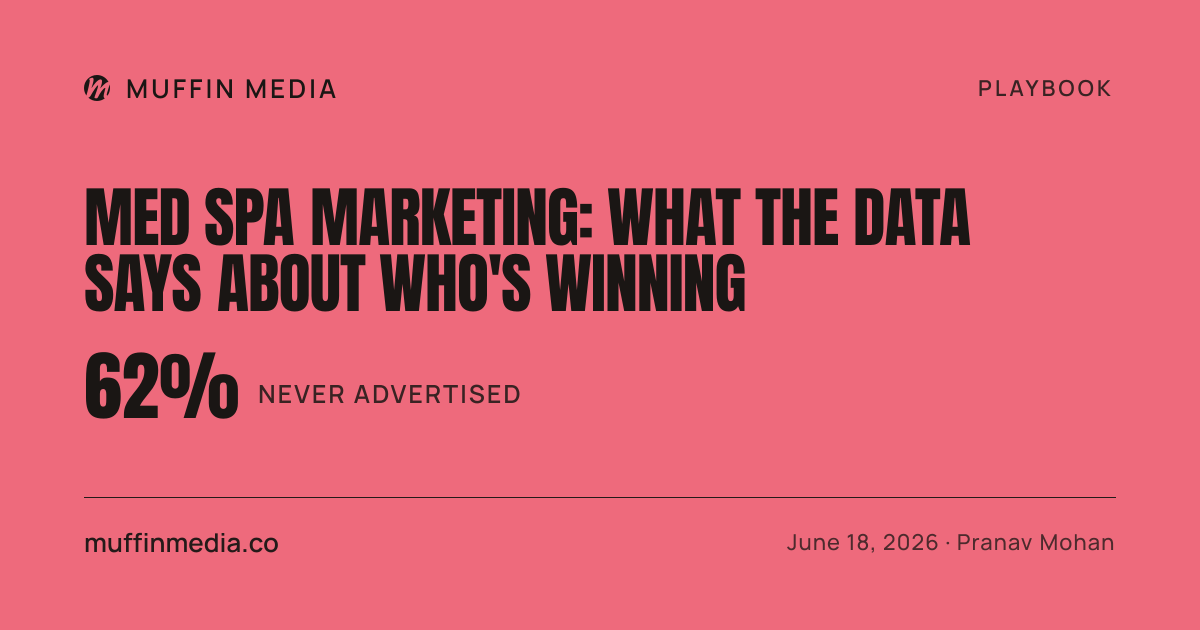
What our data does show is the cost of beginner-level execution at scale. Across 10 cities and 500 med spas, only 16.5% are advertising at all right now, despite 38% having tried at some point. The gap between "tried" and "still running" points to campaigns that underperformed and got shut down. Beginner accounts tend to run short, reactive campaigns rather than the compounding, long-running ads that our data shows drive real results.
The average longest-running ad among med spas that do advertise stays live for 478 days. One outlier held for 2,886 days. Continuity like that does not come from a distracted in-house coordinator rotating duties every quarter. It comes from an account managed with enough market context to know the ad is working and why.
The average winning med spa ad runs 478 days. In-house accounts rarely survive the first 90.
What does "beginner maturity" actually mean for a med spa ad account?
Maturity in ad accounts is measured by the sophistication of campaign structure, audience segmentation, bidding strategy, and conversion tracking. A beginner account typically has one or two campaigns, broad targeting, manual or default bidding, and limited conversion data flowing back into the platform.
Our pull of 500 med spas across 10 cities found 167 Google advertisers and 66 Meta advertisers. Of those with active accounts, 87% registered at beginner maturity. Thirteen percent sit at intermediate. The advanced category is zero.
This is not a criticism of in-house teams personally. Sophisticated ad management requires seeing failure and success at volume. An in-house manager running one account sees one set of results. An agency managing dozens of med spa accounts has seen which creative formats burn out fast, which bid strategies work in competitive cities, and which audiences convert for specific services.
The full med spa advertising research report documents this maturity breakdown across the 10-city sample in detail.
Does channel choice matter as much as people think?
Yes, and the data is clearer on this than most operators expect.
Nationally, med spas run 4.8x more ads on Google than Meta. Our 10-city pull shows nearly the same ratio at 4.9x. This is not random preference. High-intent search traffic for terms like "botox near me" or "laser hair removal [city]" converts differently than an audience that sees a scroll-stop video on Instagram.
The format breakdown on Meta is worth knowing: video accounts for 41% of med spa ads, carousel 30%, and static image 29%. Static is the lowest-cost format to produce but the smallest share of what is actually running. That gap matters if you are building creative without outside context.
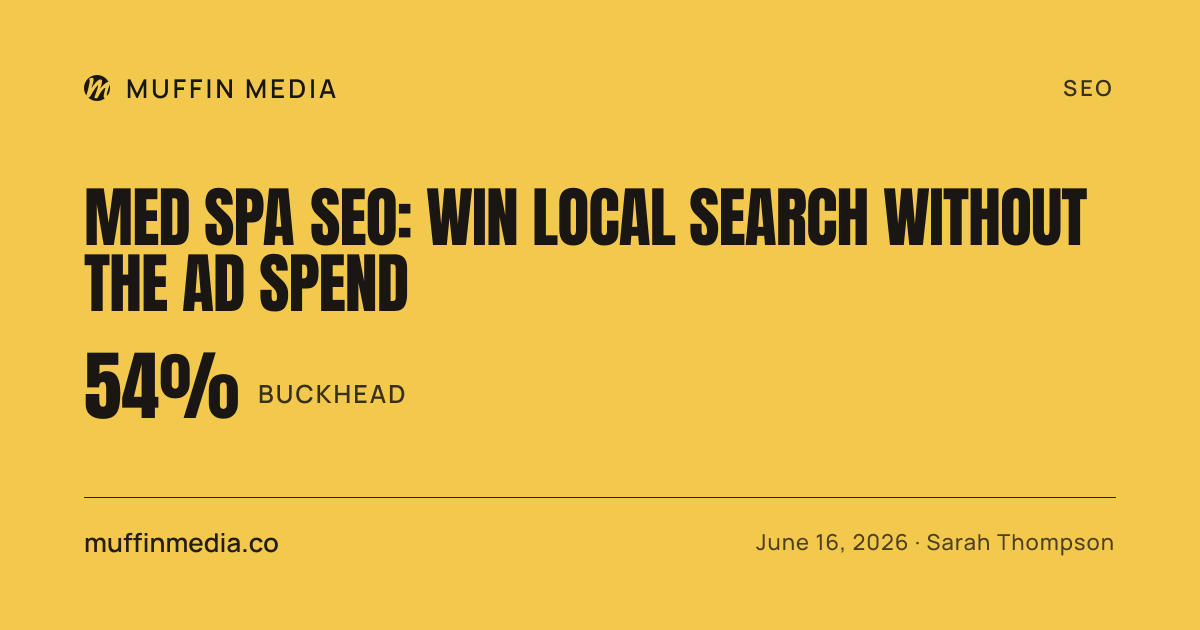
The city-level variation is even sharper. In Coral Gables, 100% of advertising med spas are on Google. Zero are on Meta. In Buckhead, 54% of spas advertise at all, the highest rate across the 10 markets. In Stamford, just 32% do. An in-house marketer allocating budget without this city-level view is guessing. An agency with live pull data is making a call based on what competitors in your exact market are already doing.
For more on channel-specific execution, Google Ads strategy for med spas and Instagram for med spas cover the tactical layer in detail.
Can a strong in-house hire close the gap?
A dedicated, experienced digital marketer with med spa category knowledge can close part of the gap. The honest answer is that the hiring bar is higher than most owners realize, and the market visibility problem remains.
A single hire sees your account, your city, and maybe your direct competitors. Our dataset shows 62% of med spas nationwide have never run a single digital ad. That means there is limited industry knowledge circulating through hiring pools. Med spa-specific ad experience is rare, and operators who do have it tend to work at agencies where they see multiple accounts.
The question worth asking is whether a strong in-house hire, at $55,000 to $85,000 annual salary plus benefits by typical industry benchmarks, gives you the same market intelligence that an agency built on a 1,995-spa pull and 10 live city monitors can. The salary cost is real. The intelligence gap is also real.
If you do hire in-house, pair that person with strong category-level resources. The med spa marketing guide for 2026 is a starting point. Local SEO for med spas and med spa lead generation cover the channels that take longer to learn from scratch.
When does agency make sense versus in-house?
Agency makes sense when speed to market matters, when you are in a competitive city, or when you are launching new services that need immediate testing against what competitors are doing.
Our data shows advertising rates range from 32% in Stamford to 54% in Buckhead. If you are opening in Buckhead, more than half your competitors are already running paid ads. You need market-level data from day one, not month nine when an in-house hire has finally found their footing.
Agency also makes sense if your conversion tracking is not clean. Most beginner-maturity accounts fail here first. Without accurate conversion data, the bidding algorithms on Google and Meta cannot optimize toward real patients, and every dollar spent is partially wasted. An agency working across multiple med spa accounts has typically already solved this integration problem and can implement it faster than a new in-house hire can research it.
In-house makes more sense when you have already established strong channel performance, have a clear playbook, and need execution capacity rather than strategy. That is an intermediate-to-advanced account position. Our data says 13% of med spas reach intermediate. That is where in-house begins to be a defensible option.
For practices in emerging markets, Scottsdale med spa marketing shows what a market with established competition looks like from a channel investment standpoint.
Also worth factoring in: compliance. Med spa advertising faces platform-specific restrictions on before-and-after imagery, claim language, and health-related ad policies. An agency managing multiple accounts in this vertical has already hit these restrictions and knows how to stay on the right side. Med spa advertising compliance is the full reference if you are managing this internally.
What does the 478-day ad tell you?
It tells you that the operators who figure out performance stop changing what is working.
Most beginner accounts over-rotate. They change creative too fast, switch campaigns before the algorithm has enough conversion data to optimize, and react to short-term performance dips that would have resolved on their own. The result is an account that never accumulates learning.
The 478-day average longest-running ad, with an outlier at nearly eight years, is not luck. It is a signal that some operators, or their agencies, found something that converted and had the discipline to leave it running. That discipline is easier to maintain when you have enough market context to know your ad is still competitive, and enough account history to know the conversion rate is holding.
Understanding med spa branding and ad costs helps frame why long-running creative pays off compounding returns over time.
This is not theory. We cut a two-location med spa's cost per lead from $47 to $18 and lifted return on ad spend to 4.6x, tracked to booked consultations rather than clicks. See the full Beverly Hills Rejuvenation Center case study.
Frequently asked questions
How much does a med spa marketing agency cost compared to hiring in-house?
Industry benchmarks put full-service med spa marketing agency retainers between $2,500 and $8,000 per month, depending on channels and scope. A dedicated in-house digital marketer runs $55,000 to $85,000 per year in salary by typical market rates, plus benefits and tools. The cost comparison narrows or reverses when you account for what the agency brings in market intelligence, account management experience across multiple clients, and faster implementation of proven frameworks. These are industry-standard ranges, not figures from our proprietary dataset.
Why do most med spas fail at in-house advertising?
Our 10-city pull of 500 med spas shows 87% of active ad accounts are at beginner maturity. The most common failure points are poor conversion tracking, over-rotation of creative before the algorithm optimizes, and limited knowledge of what competitors in the same city are actually running. In-house teams rarely have category-level visibility. They see one account in one market, which makes it hard to know whether a campaign is underperforming or simply normal for that city and service type.
Is Google or Meta better for med spa advertising?
Both channels serve different roles, but our data shows med spas run 4.8x more ads on Google than Meta nationally, with the 10-city pull confirming a nearly identical 4.9x ratio. Google captures high-intent search traffic from people actively looking for a service. Meta works better for building awareness and remarketing to past visitors. City-level patterns matter here: Coral Gables shows 100% of advertising spas on Google and zero on Meta, while other markets run a mixed strategy. The right answer depends on your services, your market, and what your specific competitors are doing right now.
Free tool
See the live ad benchmark for your city
Written by Sarah Thompson, Muffin Media

Want this run on your brief?