In a market where 54% of spas are bidding, SEO is the lane with no auction. In a quiet market, paid is faster. Most med spa marketing advice picks a side and stops there. This article does something different: it uses real ad data from 500 med spas across 10 cities to show you exactly when to weight SEO, when to weight paid, and how to read your own market before you spend a dollar.
The short answer is that neither channel wins universally. Your local ad saturation rate is the deciding variable, and most owners never look at it.
Does SEO or paid ads deliver better ROI for a med spa?
The honest answer is that it depends on what your competitors are doing right now in your specific city. A blanket answer gets you a mediocre result either way.
Paid ads work on a simple mechanic: pay, appear, stop paying, disappear. SEO builds a compounding asset. A page that ranks today keeps producing leads while you sleep, and the cost per lead drops over time as you stop paying to maintain it. Industry benchmarks put med spa Google Ads CPC somewhere between $8 and $25 per click depending on service and geography. Those are industry estimates, not our data. What our data does show is that 42% of med spas that have ever advertised keep a campaign running 180 days or longer, and the average longest-running ad in our pull ran 478 days. One outlier hit 2,886 days. Spas that keep ads that long are not doing it by accident. They are doing it because it works, which means they have the budget to sustain it.
The problem is that 87% of med spa ad accounts we reviewed scored at beginner maturity. Zero reached advanced. That means most paid ad spend in this category is structurally inefficient, and the business next door is probably leaving money on the table even when they are advertising.
For a deeper look at the full marketing picture, see our med spa marketing guide for 2026.
How competitive is paid advertising in my city?
Far more competitive in some markets than others, and the spread is wide enough to change your strategy entirely.
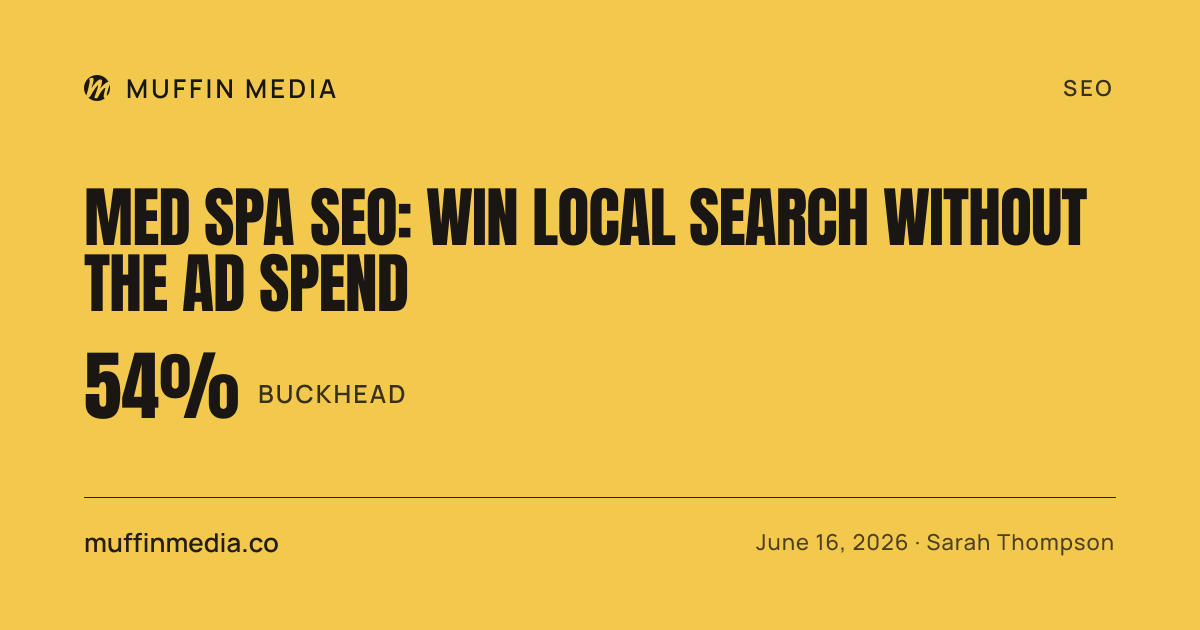
Our 10-city pull of 500 med spas found that city-level advertising rates range from 32% in Stamford to 54% in Buckhead. That is not a small difference. In Buckhead, more than half the spas near you are running ads at any given time. In Stamford, fewer than one in three are. The channel you prioritize should map to that number.
Here is what that looks like in practice. Buckhead at 54% means the Google auction is crowded. Quality scores matter, CPCs are higher, and new entrants face an uphill battle against competitors who have been running the same ad for 478 days. That is exactly where SEO creates an asymmetric advantage. You are not bidding against anyone. You are building content that compounds.
Stamford at 32% flips the logic. Organic demand exists, but paid search is relatively quiet. A well-structured Google Ads campaign can capture high-intent clicks before SEO has time to mature. Speed matters more than compounding in that scenario.
Buckhead med spa marketing is one of the most contested local markets in our dataset. If you are operating there, paid-only is a losing long game.
What does the data say about where med spas actually advertise?
Google dominates, and Meta is a secondary channel for most markets, with one notable exception.
Across our 10-city pull, med spas ran 4.9x more ads on Google than on Meta. Nationally, the ratio is 4.8x. That is a consistent signal. High-intent search captures people who are already looking for a treatment. Meta reaches people who are not looking yet, which requires a different funnel and a longer sales cycle.
The format breakdown on Meta is worth knowing if you do run social ads: video accounted for 41% of ad formats, carousel 30%, and static image 29%. Video-first creative is the current standard, not the exception.
One market broke the pattern entirely. In Coral Gables, 100% of advertising spas in our dataset were on Google, and zero were on Meta. That kind of channel concentration is rare, but it tells you something about where local buyers search. For more on channel strategy, Google Ads for med spas covers the structural setup.
The full methodology and city-by-city tables are in the 2026 med spa advertising research report.
Is there a real SEO opportunity if most spas are already advertising?
Yes, and it is bigger than most people realize.
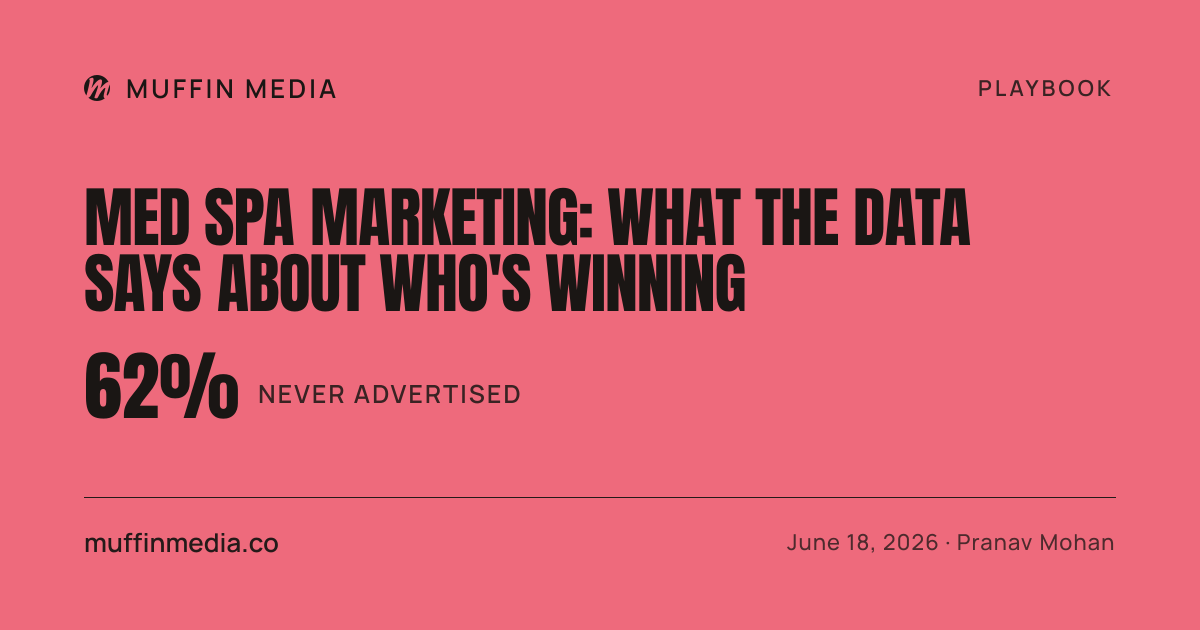
Here is the number that matters: 62% of med spas nationwide have never run a single digital ad. That sounds counterintuitive until you frame it correctly. It means most spas are competing for organic search traffic, because it is the only channel they are using. The organic search lane is not empty. It is actually where most of the competition is happening, just passively and without strategy.
The 62% who have never advertised are not hiding from the internet. They are banking on Google giving them free traffic, and most of them have no plan to earn it.
Only 16.5% of med spas are actively advertising right now, though 38% have tried at some point. The gap between "tried" and "active" suggests a lot of campaigns that ran briefly and stopped. That stop-start pattern is exactly why SEO compounding beats short-run paid campaigns for businesses without a dedicated ad budget.
If you have no advertising at all and you are starting from scratch, SEO builds a floor that does not disappear the moment you cut budget. Paid builds a ceiling that disappears immediately when you do. Which one you need first is a function of how fast you need leads and how long your runway is.
For the technical side of building that organic floor, local SEO for med spas is the place to start.
How do I actually read my local market before deciding?
Three numbers tell you almost everything you need: your city's advertising rate, the channel split between Google and Meta, and how long your top competitors have been running ads.
Start with the advertising rate. If more than 45% of spas in your area are advertising, paid search is an expensive auction and SEO is your differentiated bet. Below 35%, paid is faster and the auction is cheaper.
Next, look at channel split. If your market leans heavily Google (like Coral Gables), that tells you where buyers search and where to start. If Meta is active, it means some competitors are running awareness funnels, which often means longer-consideration services like body contouring or full membership packages.
Finally, ad longevity matters. A competitor who has run the same Google ad for 400-plus days has data. They have tested creative, optimized targeting, and found an ROI that justifies the spend. Do not assume you can out-bid them in month one. Either find a different keyword cluster or build the SEO content that flanks their paid position.
For markets with complex competitive dynamics, med spa lead generation covers how to structure a multi-channel approach without wasting budget.
Also factor in compliance before you finalize creative. Med spa advertising compliance covers what you cannot say in ads, which affects both paid and organic content strategy.
What does the right SEO and paid mix actually look like?
The right mix is not a fixed percentage. It is a starting weight that shifts as your market and your content mature.
For a new practice in a high-saturation market (45%+): start SEO-heavy. Build location pages, service pages, and topical content before you burn budget on a bidding war you are not ready to win. Use a small paid budget for retargeting only, capturing people who already visited your site.
For a new practice in a low-saturation market (under 35%): run paid from day one to get immediate visibility, and build SEO in parallel. When organic starts producing leads, you have the option to dial back paid spend or reallocate it to expansion.
For an established practice with organic rankings: use paid tactically for new service launches, seasonal promotions, or markets where you want to expand. Do not run paid continuously for services where you already rank on page one. You are paying for clicks you would have gotten for free.
The underlying principle is that SEO and paid are not competitors. They answer different buyer stages. Paid captures now-intent. SEO captures consideration-stage buyers who are researching options and will book when they are ready. A practice that does both, calibrated to local saturation, runs a more resilient business than one that picks a side and sticks to it.
For conversion thinking once the traffic arrives, med spa website conversion covers what happens after the click.
Frequently asked questions
How long does med spa SEO take to show results?
Most med spa SEO campaigns start showing measurable movement in organic rankings within three to six months, with meaningful lead volume usually appearing around month four to nine. The timeline depends on how competitive your local market is, how much existing domain authority your site has, and how aggressively you publish and build links. High-saturation markets take longer. If you need leads inside 60 days, paid search is the faster path while SEO builds.
Should a new med spa start with Google Ads or SEO?
For most new practices, a modest Google Ads budget alongside foundational SEO work is smarter than picking one exclusively. Paid gives you immediate data: which services drive clicks, which keywords convert, what your cost per booking actually looks like. That data makes your SEO investment smarter because you know which terms are worth ranking for. If budget is very limited, prioritize your Google Business Profile and local SEO first, since those are free and drive significant foot traffic.
How much should a med spa spend on Google Ads?
Industry benchmarks suggest that med spas running Google Ads typically spend between $1,500 and $5,000 per month to see meaningful results, though market conditions vary significantly. These are industry estimates, not figures from our dataset. In high-saturation markets like Buckhead, competitive keyword CPCs push budgets higher. In lower-saturation markets, the same budget goes further. Before setting a number, calculate your average booking value and your acceptable cost per lead, then work backward from there.
Free tool
See the live ad benchmark for your city
Written by Pranav Mohan, Muffin Media

Want this run on your brief?