87% of advertising med spas are still beginners. The trend that matters is not that number holding steady. It is the small group professionalizing fast and pulling away from everyone else.
That is the actual story in our national ad dataset covering 1,995 med spas and a live 10-city pull across 500 locations. Most med spa marketing trend coverage recycles the same generic predictions: post more video, optimize your Google Business Profile, run seasonal promotions. None of it is grounded in what spas are actually doing with their ad dollars. This article is.
What follows is a data-first breakdown of where med spa advertising stands today, where it is going, and what the gap between beginner and professional operators looks like in practice. If you want the full methodology and raw numbers, start with our 2026 Med Spa Advertising Report.
What does the current state of med spa advertising actually look like?
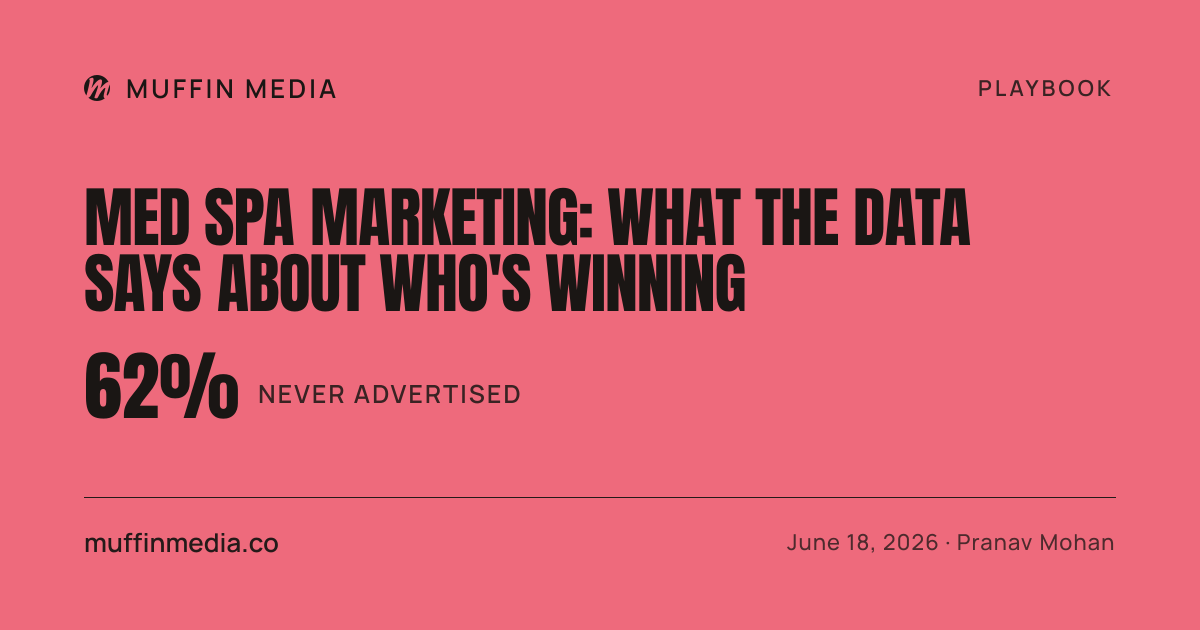
Most med spas are not advertising at all. Only 16.5% of the 1,995 spas in our national dataset are running paid ads right now. Another 21.5% have tried at some point but gone dark. That leaves 62% who have never run a single digital ad.
The opportunity gap is real, but it cuts both ways. For the spas that are advertising, competition in most markets is still thin. For the spas sitting out, the window to enter before that changes is narrowing.
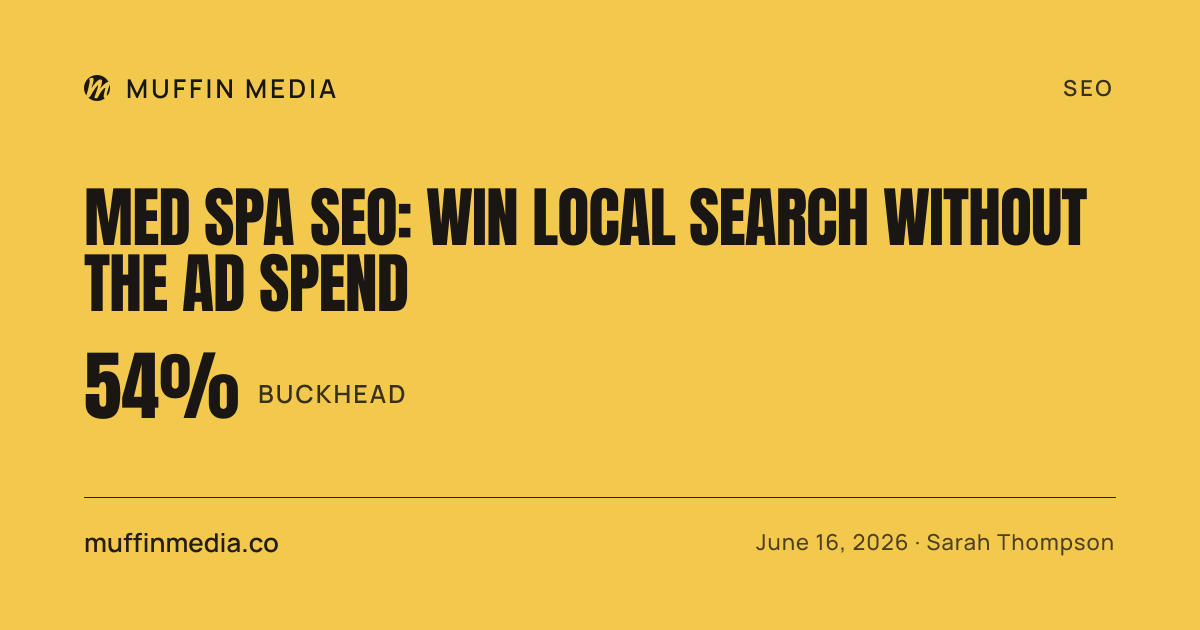
Across our 10-city pull, advertising rates range from 32% in Stamford to 54% in Buckhead. Buckhead is worth watching closely. More than half the market is active, which means the baseline expectation for patients there includes seeing your spa online before they book. Markets that look more like Stamford today will follow.
The channel split tells its own story. Med spas run 4.8 times more ads on Google than Meta nationally, and 4.9 times across our 10-city pull. This is not a preference for search over social. It reflects where most operators feel safest. Google Search maps to intent. Meta requires creative. Most beginners default to the channel that feels less like a gamble. Coral Gables makes this visible in raw form: 100% of advertising spas there are on Google, zero on Meta.
Why does the maturity gap matter more than any single tactic?
Maturity is the metric that explains why some med spas compound their results while others stay flat. In our dataset, 87% of med spas with active ad accounts score at beginner maturity. Zero percent reach advanced. The intermediate tier is thin.
Beginner maturity means running ads without a real system: no consistent creative rotation, no campaign architecture that separates awareness from conversion, no measurement setup that connects ad spend to actual booked appointments. These spas are not wasting money because they chose the wrong platform. They are running single campaigns with minimal structure and hoping for leads.
The professional operators look different. They run both channels with purpose. They test creative formats systematically. They do not stop campaigns when summer slows down. The data shows this directly: the average longest-running med spa ad in our dataset has been live for 478 days. One campaign has been running for 2,886 days. That is eight years of continuous paid advertising.
The average med spa ad has been running for 478 days. The operators who figured out always-on advertising years ago are not going to lose their momentum to a spa that just launched its first Google campaign this quarter.
That number points to a specific behavior shift. These are not seasonal blasts. They are infrastructure. The med spa marketing guide for 2026 covers how to build that kind of system from the ground up, including the measurement pieces most beginners skip.
Is video on Meta actually worth the production investment?
Yes, and the data supports it. Video is now 41% of Meta ad formats across our pull. Carousel sits at 30%, static image at 29%. Video has passed both as the dominant format.
This is a meaningful shift because Meta video requires more production effort than a static image or a product carousel. The spas running video are not doing it because it is easier. They are doing it because it converts. That said, industry benchmarks suggest Meta cost-per-lead for med spa services runs roughly $15 to $45 depending on treatment category and creative quality. Those are industry ranges, not our proprietary numbers. Your actual CPL will depend on offer, targeting, and how well your landing page handles the traffic.
The practical read: if your Meta presence is static images only, you are competing against 29% of the creative pool and underweighting the format that the professional tier has already moved toward. The Instagram for Med Spas spoke covers format-by-format production options that work without a full video crew.
One thing to watch is compliance. Med spa advertising on Meta faces category-level restrictions on before/after imagery and claims. Video creative requires the same legal attention as any other format. Our advertising compliance guide covers the platform rules that trip up most first-time video advertisers.
What does always-on advertising mean in practice for a busy med spa?
Always-on does not mean spending more. It means spending continuously at a level your operation can sustain, rather than running in bursts tied to promotions.
42% of med spas that have ever advertised keep a campaign running 180 days or longer. That 42% is not a majority, but it is the segment producing compounding results. The reason is straightforward. Google's algorithm rewards campaign continuity with better Quality Scores over time. Your account builds conversion history that makes your targeting smarter. Your creative tests accumulate enough data to be meaningful. None of that happens in a 30-day campaign.
For a med spa doing $80,000 to $150,000 per month in revenue, industry benchmarks suggest a sustainable ad budget sits around 7 to 12% of revenue. That is an industry range. What the proprietary data shows is that the operators actually sustaining always-on campaigns are not necessarily spending more than their peers in raw dollar terms. They are spending consistently while everyone else stops and starts.
The Google Ads guide for med spas covers how to structure a campaign that can run continuously without requiring weekly management intervention, including which bidding strategies hold up over longer periods.
Which cities should you watch as leading indicators?
Buckhead is the most active market in our pull at 54% advertiser penetration. Stamford is the quietest at 32%. These are not random differences. They track with market concentration, average treatment price, and how long the local med spa sector has been competitive.
Cities that are currently quiet tend to follow the path of cities that developed earlier. If your market looks like Stamford right now, the Buckhead trajectory is a reasonable model for where it goes over three to five years. The local spas that build advertising infrastructure now will have campaign history, brand recognition, and patient databases that newcomers cannot replicate quickly.
Local SEO for med spas is especially relevant in lower-penetration markets, where organic search still captures meaningful volume that has not been locked up by paid competition. That balance shifts as more local competitors turn on ads.
What should a mid-stage med spa prioritize right now?
The data points to three specific moves. Not a comprehensive strategy, but the highest-leverage gaps relative to where the market actually sits.
First, commit to Google as infrastructure. 167 of the 500 spas in our 10-city pull are on Google, versus 66 on Meta. Google is where most of the industry has already concentrated. That is both a competition reality and a validation signal. If you are not on Google Search yet, you are missing the channel where patients are actively looking. The lead generation guide covers the full patient acquisition funnel, including how Google and Meta play different roles.
Second, add Meta video before the format competition catches up. Right now, video is 41% of the Meta creative pool and rising. Static image is already being outpaced. A spa that builds a basic library of treatment explainers and patient testimonials in 2025 will be in a stronger position than one that waits until video is 65% of the pool and production demand drives up costs.
Third, invest in what happens after the click. Med spa website conversion is one of the highest-return improvements most spas can make right now. The advertising data shows where most of the industry is spending. What it also shows is that beginner-maturity operators often have strong enough ad setups to generate clicks. The breakdown happens on the landing page. A 15% improvement in booking conversion rate is worth more than a 15% increase in ad spend.
Retention and membership programs also compound the math. Acquiring a new patient costs real money at any reasonable CPL. Med spa memberships and retention covers the models that turn a one-time injectable patient into a recurring revenue line.
Frequently asked questions
What are the biggest med spa marketing trends for 2026?
The data-supported trends are: a slow but accelerating shift toward advertising adoption (16.5% active now, 38% have tried), the dominance of always-on Google campaigns among professional operators (478-day average ad longevity), and video overtaking static as the lead format on Meta at 41% of the creative mix. The meta-trend underneath all of these is maturity: the gap between beginner and professional operators is widening, and the spas building systematic advertising infrastructure now are compounding their advantage each month.
How much should a med spa spend on digital advertising?
Industry benchmarks suggest a range of 7 to 12% of monthly revenue for practices actively trying to grow. That is not a proprietary finding, it is a commonly cited range among healthcare marketing practitioners. What matters as much as the total is the consistency. Our data shows that 42% of med spas that ever advertised maintain campaigns for 180 days or longer. Campaign continuity tends to produce better algorithmic performance on both Google and Meta, which means a sustainable ongoing budget often outperforms a larger burst budget that gets paused after a slow month.
Is Meta or Google better for med spa advertising?
Both channels serve different roles and the data supports running both if your budget allows. Google captures intent: patients searching "Botox near me" are ready to book. Meta creates demand and keeps your spa visible to people who are not actively searching yet. Nationally, med spas run 4.8 times more ads on Google than Meta, which reflects where the industry feels more confident. But the professional-tier operators run both. If you are choosing one to start, Google Search is the higher-intent channel. When you add Meta, branding and ad creative become important factors in whether the spend produces results.
Free tool
See the live ad benchmark for your city
Written by Pranav Mohan, Muffin Media

Want this run on your brief?