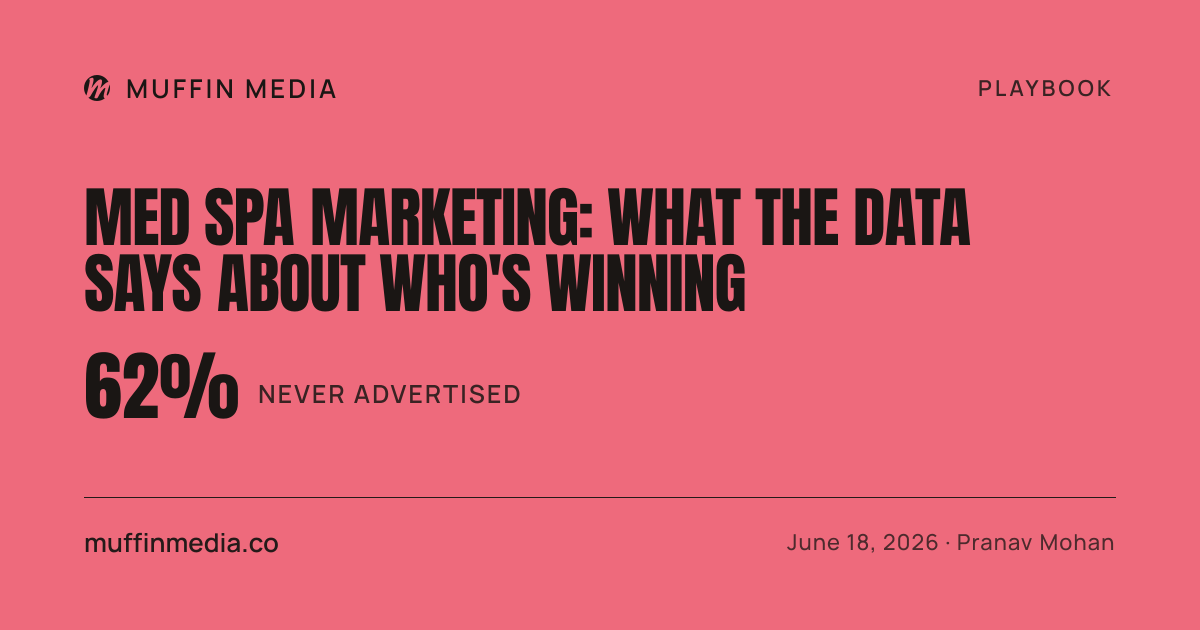
The med spas with the best returns run ads for 478 days on average. They measure lifetime value, not the first booking.
That single shift separates the practices growing 30% year-over-year from the ones cycling through agencies, blaming the channel, and starting over. The math is not complicated. The discipline is.
What does med spa marketing ROI actually mean?
ROI in med spa marketing means total revenue generated per dollar spent across the full client relationship, not just the first appointment. A client who books a $200 hydrafacial is not a $200 client. If she converts to a monthly membership, that relationship is worth closer to $2,400 over twelve months. Those are illustrative numbers to show the structure of the math, but the principle holds across services and price points: the first transaction is just the cost of acquiring a relationship.
Most practices do not track it this way. Our national med spa advertising study found that 87% of med spas with active ad accounts score at beginner maturity on attribution. Zero percent score advanced. That means the vast majority of spending decisions are made without any reliable signal on which campaigns are actually generating long-term revenue.
Why do so many med spas feel like marketing isn't working?
They're measuring the wrong thing. When you spend $1,500 on Google ads in March and your front desk reports 11 new bookings at an average of $180, you do the math and decide ads don't work. But if four of those clients joined your membership, you didn't make $1,980. You acquired roughly $9,600 in annual recurring revenue for $1,500. That's a 540% return, measured correctly.
The reason this gets missed is structural. Most practices book appointments in one system, track payments in another, and run marketing in a third. Nobody connects the chain. So the signal that reaches the owner is always "cost per booking," which always looks worse than it is.
The practices that run ads for over 478 days aren't stubborn. They've done the math on lifetime value and they know the channel works.
Industry benchmarks put Google Ads cost-per-lead for med spas in the $40 to $120 range, depending on market and offer. Those are external benchmarks, not our proprietary data. Even at $120 per lead and a 25% close rate, you're spending $480 to acquire a client. If that client converts to a membership, she's worth $2,400 this year and likely more in year two. The unit economics only look bad if you stop the calculation at the first transaction.
Which advertising channels are med spas actually using?
Google dominates by a wide margin. Across our 10-city pull of 500 med spas, we found 167 Google advertisers versus 66 on Meta. That's a 4.9-to-1 ratio, which mirrors the national picture almost exactly: 4.8-to-1 Google versus Meta across roughly 2,000 spas in our broader dataset.
That ratio tells you something about where buyers are in the funnel when they find med spa ads. Google captures active search intent. Someone typing "botox near me" is already decided on the category; they're choosing a provider. Meta catches people who weren't looking. Both channels work, but they work differently, and expecting the same cost-per-acquisition from each is a setup for bad decisions.
One market makes the point sharply. In Coral Gables, 100% of advertising spas are on Google and zero are on Meta. That's not a coincidence of sample size. It reflects a market dynamic worth understanding if you're building a local presence in South Florida or similar competitive urban corridors.
The format mix on Meta skews toward video: 41% of Meta ads in our dataset are video, 30% carousel, 29% static image. If you're allocating Meta budget, video is what the competitive set is doing.
How long should you run a med spa ad campaign before judging it?
At least 90 days before drawing any conclusions, and longer before making major changes. The average longest-running ad in our dataset runs 478 days. One ad in the dataset ran for 2,886 days. Those are not accidents.
Forty-two percent of med spas that have ever advertised keep at least one campaign running for 180 days or more. The practices doing this aren't running the same underperforming creative out of laziness. They've found something that converts and they're protecting it.
This matters for ROI math because ad platforms reward continuity. Google's algorithm improves quality scores over time. Meta's delivery system needs conversion data to find the right audience. Campaigns that get killed at week six never accumulate the data needed to optimize. The ROI looks low because you never stayed long enough to let it compound.
New practices should budget mentally for a 90-day learning window. Industry norms suggest allocating $2,000 to $5,000 per month during that period, again, external benchmark, not our data. After 90 days, you have enough signal to scale what's working and cut what isn't.
What does med spa advertising look like across different markets?
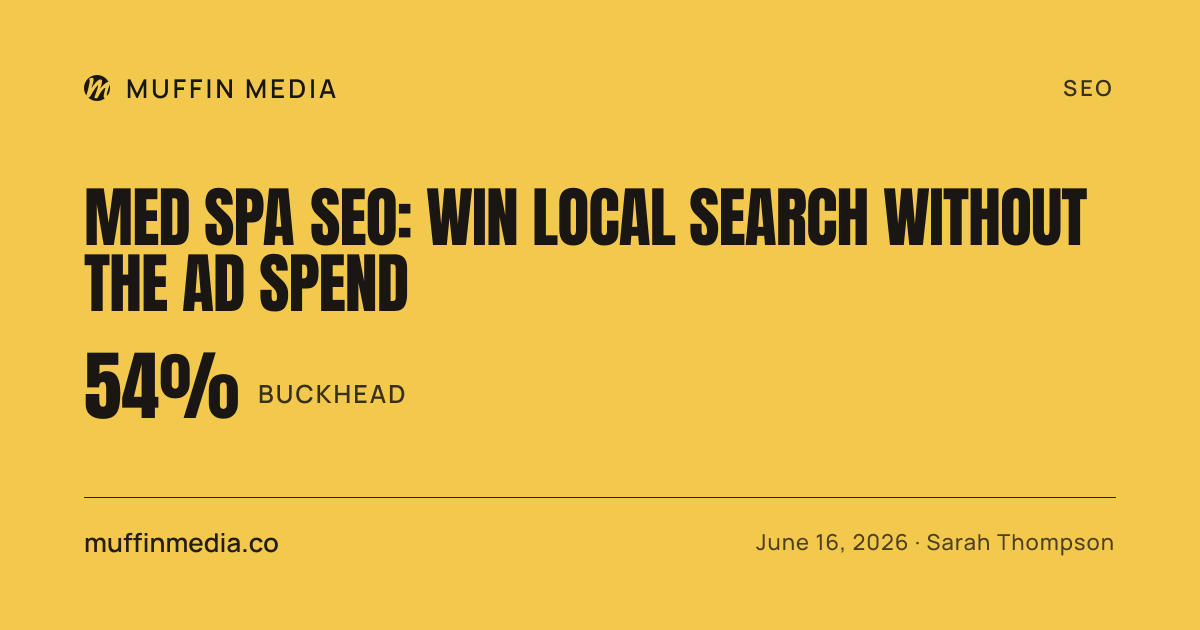
Coverage varies significantly. Across our 10 markets, the share of spas actively advertising ranges from 32% in Stamford to 54% in Buckhead. Nationally, only 16.5% of med spas are advertising right now, though 38% have tried at some point.
That gap, between the 38% who've tried and the 16.5% currently active, is where most of the "marketing doesn't work" stories come from. Practices tried it, didn't measure lifetime value, concluded the ROI wasn't there, and stopped. The 16.5% still running are largely the ones who figured out the measurement.
In Buckhead, where more than half of practices are actively advertising, the competitive pressure is high enough that not advertising is itself a strategic choice with consequences. If you're in a market where 54% of your peers are running Google ads and you're not, you're ceding top-of-funnel to them.
If you're in a market at the lower end of that range, the opportunity is different. You're not fighting for share. You're building a category position before the market gets crowded. The local SEO opportunity compounds over time the same way paid does, but the lead time is longer.
For a fuller picture of what the competitive set looks like in your specific market, the med spa advertising 2026 report breaks down channel use, ad volume, and maturity scores by city.
How do memberships change the ROI calculation?
Dramatically. A membership program converts a transactional relationship into a predictable revenue stream, and that changes every number in your marketing model.
Take a client who comes in for a $200 treatment. Without a membership, your customer acquisition cost needs to be well below $200 to show a positive first-transaction return. That's a tight constraint. With a membership that generates $200 per month, that same client generates $2,400 over twelve months. Your allowable acquisition cost just multiplied by twelve.
This is why the practices in our dataset running ads for 478-plus days look rational rather than stubborn. They've done the math. They know a Google lead that costs $80 and converts to a $200/month membership is a 30-to-1 return over the year. They're not measuring cost-per-click. They're measuring cost-per-retained-client.
The membership and retention mechanics that make this work involve more than just offering a monthly plan. Pricing structure, cancellation terms, service variety, and onboarding all affect retention rates. A membership that churns at 60 days doesn't change the math as favorably as one that holds for 14 months. But even a modest retention rate reshapes the ROI equation completely.
Building out your website's conversion path to surface the membership offer early in the client journey is part of the infrastructure. Paid traffic that lands on a booking page for a single treatment misses the upsell entirely.
What tracking setup do you need to actually measure this?
You need three things connected: your ad platform, your booking system, and your revenue data. That sounds obvious. In practice, 87% of med spas with active ad accounts don't have it.
At minimum, you need Google Analytics 4 with conversion events firing for form submissions and phone calls, and those conversions imported into Google Ads so the platform can optimize toward them. That gets you cost-per-lead by campaign. It doesn't get you lifetime value.
Lifetime value tracking requires connecting your booking system to your revenue data and tagging clients by acquisition source. Some EMR and booking platforms support this natively. Others require a simple CRM layer in between. The goal is a report that shows, for every client acquired through paid search in Q1, what their total revenue was at the 90-day, 180-day, and 12-month marks.
This is not advanced analytics. It's the baseline you need to make a rational marketing budget decision. Without it, you're setting spend levels based on intuition and hoping the first-booking math works out. With it, you can calculate a maximum allowable CPA with confidence and scale accordingly.
The med spa lead generation framework and the Google Ads operational guide both cover the technical setup in more detail. The full marketing guide ties the channels together into a coherent growth model.
This is not theory. We cut a two-location med spa's cost per lead from $47 to $18 and lifted return on ad spend to 4.6x, tracked to booked consultations rather than clicks. See the full Beverly Hills Rejuvenation Center case study.
Frequently asked questions
What is a realistic ROI target for med spa marketing?
There's no universal number, but a useful frame is cost-per-acquired-client versus 12-month client value. If your membership generates $2,400 per year and your cost to acquire a converting client (accounting for close rate) is under $400, you're running at better than 5-to-1. Industry benchmarks for healthcare and aesthetics services suggest a 3-to-1 return is a reasonable floor; above 5-to-1 is strong. Track to 12 months, not to first transaction.
How do I know which channel, Google or Meta, will give better ROI for my spa?
Start with Google if you're in a search-intent category like injectables or laser treatments, where buyers are actively looking. Meta works better for generating awareness around new services or converting lookalike audiences from your existing client list. Our data shows Google advertisers outnumber Meta advertisers nearly 5 to 1 in the markets we've tracked, which reflects where purchase-ready traffic sits. That said, a combined strategy typically outperforms either channel alone once you have membership economics working.
How long before I can accurately measure med spa marketing ROI?
Plan for 90 days before drawing conclusions about a campaign, and 12 months before you have a reliable read on lifetime value. The 90-day window gives ad platforms enough conversion data to optimize delivery. The 12-month window captures membership retention, repeat visits, and referrals generated by the cohort. Practices that judge campaigns at 30 or 60 days are almost always cutting winners because the data is too thin to show the full return.
Free tool
See the live ad benchmark for your city
Written by Pranav Mohan, Muffin Media

Want this run on your brief?